When building modern applications, navigating the Software Development Lifecycle effectively is crucial for success across nearly every industry, from healthcare and banking to retail and entertainment. Behind every reliable application is a structured framework that ensures quality, security, scalability, and business value. Organizations that follow a well-defined SDLC reduce project risks, improve collaboration, accelerate delivery, and produce digital products that align with business goals.
Whether building an enterprise platform, a mobile application, or an AI-powered solution, understanding these stages helps stakeholders make informed decisions and achieve predictable outcomes.
The Core Philosophy: In practice, each stage benefits from cross-functional collaboration between business stakeholders, architects, developers, testers, security engineers, and operations teams. Documentation, measurable objectives, automation, and continuous feedback ensure that quality is maintained from start to finish. Organizations that treat this as an iterative improvement process are better positioned to respond to changing market demands, reduce technical debt, and deliver exceptional customer experiences.
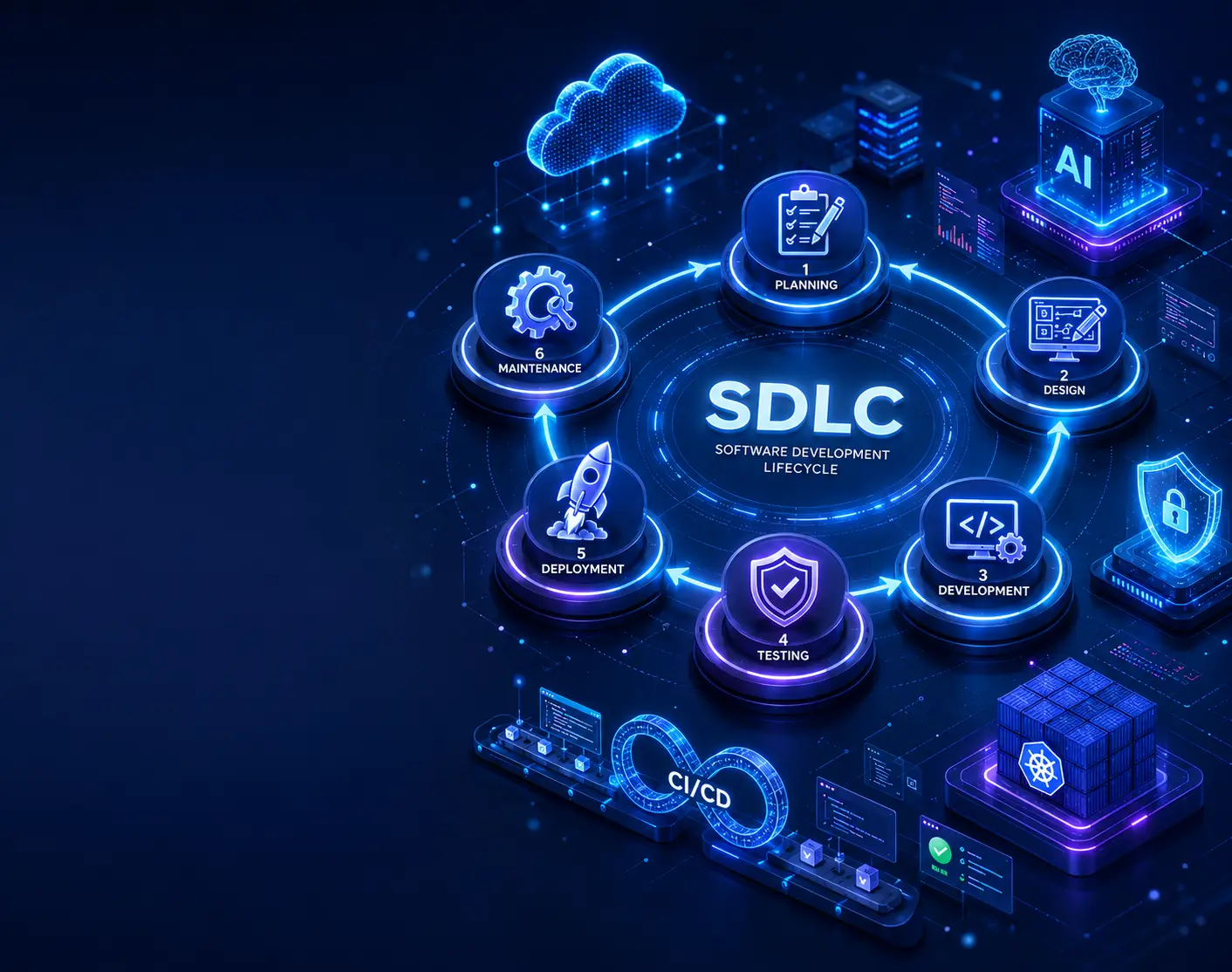
The 6 Key Stages of the Software Development Lifecycle
1. Planning & Requirement Analysis
The process begins by identifying business objectives, understanding user expectations, gathering functional and non-functional requirements, estimating timelines and budgets, and assessing project feasibility. Strong planning reduces costly changes later on.
2. System Design
Architects translate requirements into technical blueprints. This stage includes system architecture, database design, APIs, security considerations, UI/UX wireframes, cloud infrastructure, and technology selection. Good design improves scalability and maintainability.
3. Development
Developers convert approved designs into production-ready code using coding standards, version control, peer reviews, CI/CD pipelines, and automated testing. Agile teams deliver functionality in incremental sprints while maintaining quality.
4. Testing & Quality Assurance
Testing validates that the product performs as expected. Functional, integration, regression, performance, usability, and security testing help identify issues before production. Automation accelerates release cycles while maintaining reliability.
5. Deployment
After successful validation, the code is deployed to staging and production environments. Modern IT practices use automated pipelines, containerization, Kubernetes, blue-green deployments, and monitoring to minimize downtime.
6. Maintenance & Continuous Improvement
The workflow does not end after release. Teams continuously monitor application performance, fix bugs, deliver feature enhancements, strengthen security, and optimize infrastructure based on user feedback and analytics.
Popular SDLC Models
Organizations choose different models depending on project complexity and business needs. Each framework has advantages depending on project size, regulatory requirements, and release frequency.
- Waterfall: Best for fixed-scope, well-understood projects.
- Agile & Scrum: Widely preferred for evolving business requirements and iterative delivery.
- Spiral: Focuses heavily on risk assessment for complex, high-stakes projects.
- V-Model: Emphasizes verification and validation at each corresponding stage.
- DevOps-enabled Continuous Delivery: Automates pipelines for rapid, reliable delivery.
Best Practices for SDLC
- Clearly define and document all requirements.
- Involve stakeholders early and consistently.
- Adopt Agile methodologies where appropriate to stay flexible.
- Automate testing and deployment to reduce human error.
- Prioritize security from day one (DevSecOps).
- Use scalable, cloud-native architecture.
- Continuously monitor production environments for proactive maintenance.
- Measure KPIs and improve processes iteratively.
How Unanimous Technologies Adds Value
At Unanimous Technologies, engineering combines business understanding with modern practices. From requirement discovery and architecture to cloud-native builds, DevOps automation, AI integration, quality assurance, deployment, and ongoing support, the focus remains on delivering scalable, secure, and high-performance digital products tailored to your objectives.
Conclusion
A structured Software Development Lifecycle provides clarity, minimizes project risk, improves software quality, and accelerates innovation. Organizations that invest in disciplined SDLC practices consistently deliver software that is scalable, maintainable, and aligned with evolving customer needs.
Ready to transform your software idea into a scalable digital solution?
Partner with Unanimous Technologies to build secure, future-ready applications using proven SDLC methodologies, Agile development, cloud-native architecture, DevOps automation, and AI-driven innovation.
Contact our team today to discuss your next software project and discover how we can accelerate your digital transformation journey.
Frequently Asked Questions
Q1. What is SDLC?
The Software Development Lifecycle is a structured framework for planning, designing, developing, testing, deploying, and maintaining software.
Q2. Which SDLC model is best?
Agile is widely preferred for evolving business requirements, while Waterfall suits fixed-scope projects.
Q3. Why is testing important?
Testing improves quality, security, reliability, and user satisfaction while reducing production defects.
Q4. How does DevOps improve SDLC?
DevOps automates development, testing, deployment, and monitoring, enabling faster and more reliable software delivery.