Introduction: The Great Architectural Shift
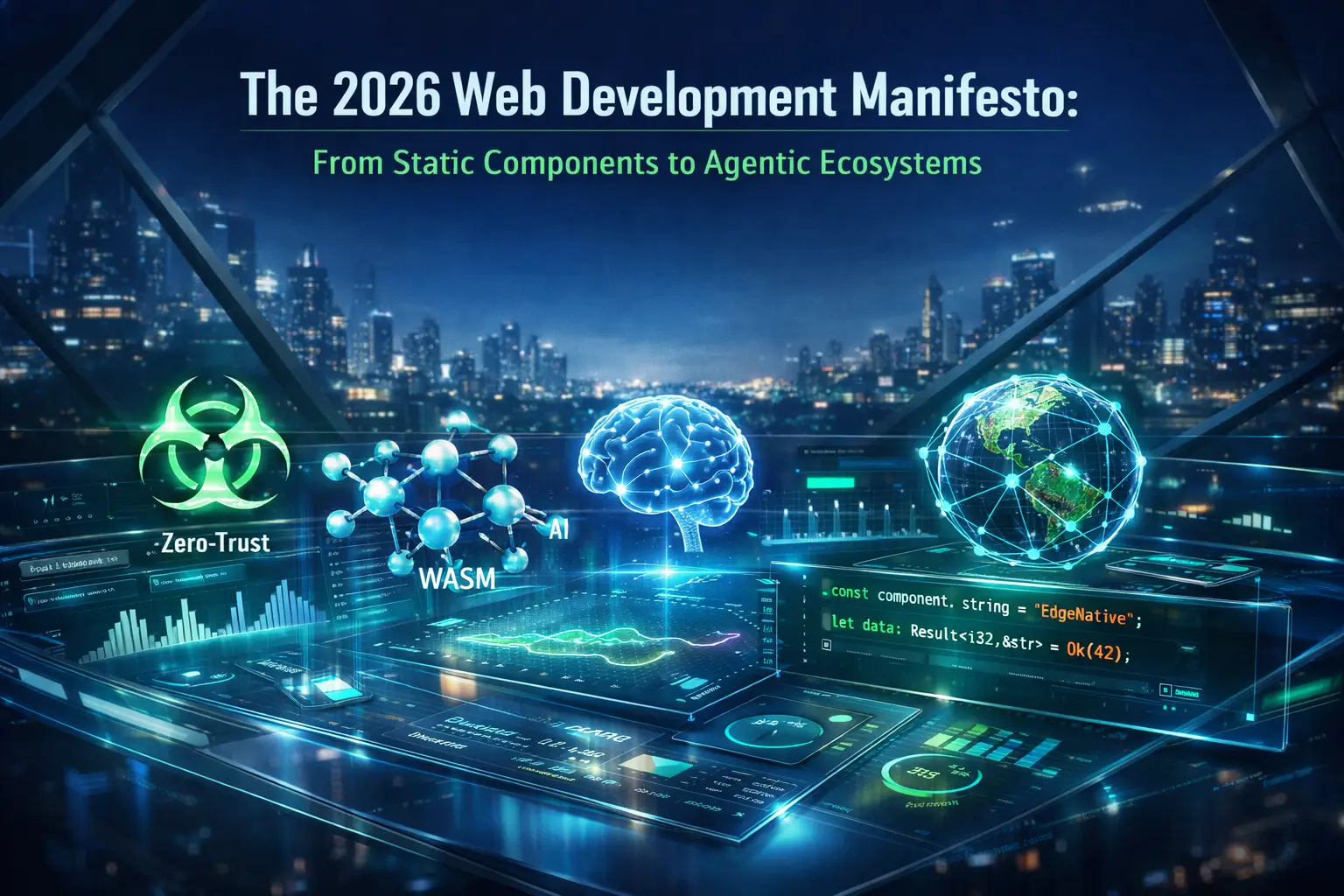
The 2026 Web Development Manifesto marks a fundamental shift in how we design, build, and scale digital experiences in an AI-driven world. As we move through 2026, the definition of a “web application” has undergone a fundamental metamorphosis. If 2021 was about the rise of the Jam-stack and 2024 was about the integration of basic AI wrappers, 2026 is defined by Autonomous Integration. At Unanimous Technologies, we are no longer just building interfaces that respond to clicks; we are architecting systems that anticipate intent.
The industry has moved beyond the “Component-Based Era.” We are now in the Runtime-Agnostic Era, where code is expected to run with equal performance on a browser, a mobile device, or a localized Edge server. This article serves as a strategic roadmap for CTOs, Lead Developers, and Product Owners looking to navigate the complex waters of 2026’s digital landscape. At its core, The 2026 Web Development Manifesto focuses on scalability, intelligence, and adaptability.
1. Agentic UI: The End of Predictable User Paths
The most visible trend of 2026 is the transition from Deterministic UI to Agentic UI. In traditional web development, we spend months mapping out user journeys—UI/UX designers create Figma flows, and developers implement rigid routes. The 2026 Web Development Manifesto emphasizes agentic systems over static UI components.
What is Agentic UI?
Agentic UI refers to interfaces that are generated or modified in real-time by an AI agent that understands the application’s underlying state and the user’s specific goal.
- Generative Components: Instead of a static “Search Results” page, the application uses a Large Language Model (LLM) to determine that the user is trying to compare three specific products. It then renders a custom comparison table that didn’t exist in the source code.
- Contextual Awareness: The UI adapts based on the “state of mind” of the user. If the system detects a user is struggling with a complex DevOps configuration on the Unanimous platform, the UI simplifies itself, highlighting only the “Happy Path.”
Technical Implementation
To achieve this, we are seeing the rise of JSON-to-UI engines. Frameworks like React and Next.js are now being paired with “UI-LLM Bridges” that take structured data from an AI agent and map it to a library of pre-validated, accessible components. This ensures that while the layout is generative, the brand identity and accessibility (WCAG 4.0) remain intact.
2. The WebAssembly (Wasm) Component Model
For years, WebAssembly was relegated to video games and heavy image editors. In 2026, Wasm is the backbone of the enterprise web. The breakthrough came with the Wasm Component Model, which allows for “Language Polyglotism” within a single application.
Why It’s a Trend in 2026
Modern web apps are now too complex for JavaScript alone. We are seeing:
- High-Speed Data Processing: Companies are writing their core business logic in Rust or Go, compiling it to Wasm, and running it in the browser at near-native speeds.
- Shared Logic: At Unanimous Technologies, we can now use the exact same validation logic in our Python backend and our React frontend by using a shared Wasm module.
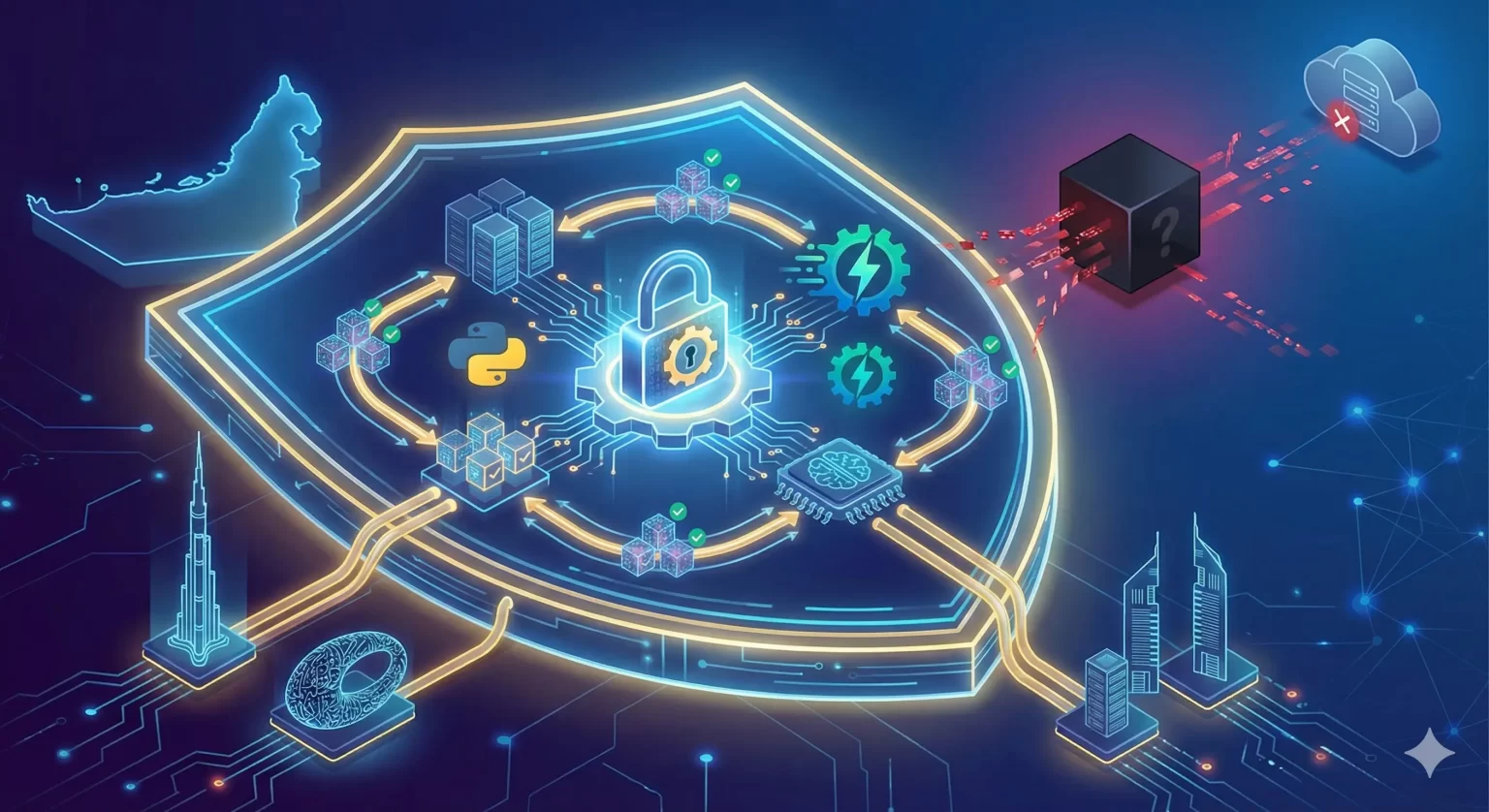
- Security Sandbox: Wasm provides a capability-based security model, meaning third-party plugins can run in the browser without having access to the user’s cookies or sensitive DOM elements.
3. Edge-Native: Moving Beyond the Centralized Cloud
In 2026, the “Cloud” is no longer a data center in Northern Virginia (AWS us-east-1). The Cloud is everywhere. Edge-Native Architecture is the practice of building applications where the default deployment target is the Global Edge Network. According to The 2026 Web Development Manifesto, edge-native architecture is no longer optional.
The Death of Latency
With providers like Cloudflare, Vercel, and Akamai offering “Compute at the Edge,” we have moved past simple Content Delivery Networks (CDNs).The 2026 Web Development Manifesto also highlights the importance of combining AI with edge-native infrastructure for real-time adaptability.
- Edge Databases: Technologies like Turso and Cloudflare D1 allow us to replicate data globally. When a user in Tokyo hits a Unanimous-built site, their data is served from a Tokyo-based SQLite instance, not a primary DB in the US.
- Streaming Server-Side Rendering (sSSR): By utilizing Edge functions, we can start streaming the HTML shell to the user in under 10ms, while the heavy data-fetching happens in parallel across the global backbone.
4. The Maturity of “Full-Stack Meta-Frameworks”
The “Frontend vs. Backend” divide is officially a legacy concept. In 2026, frameworks like Next.js 16, Remix Evolution, and Nuxt 4 have unified the development experience.
Unified Type Safety
Thanks to the widespread adoption of TypeScript 6.x, we now have “End-to-End Type Safety” (E2E TS) as a standard. If a developer changes a column name in the database schema, the IDE immediately flags an error in the frontend React component. This has drastically reduced the need for manual API documentation tools like Swagger, as the code itself is the documentation.
Server Actions and Forms
The “API Layer” is disappearing. Developers now write “Server Actions” that look like regular JavaScript functions but execute securely on the server. This reduces the boilerplate of writing Fetch requests and managing loading states, allowing Unanimous Technologies to deliver projects 40% faster than two years ago.
5. Zero-Trust Security and the Passkey Revolution
Web security in 2026 is no longer about “firewalls.” It is about Identity. With the total collapse of password-based security due to AI-driven credential stuffing, the web has moved to a Zero-Trust model. Following The 2026 Web Development Manifesto allows teams to move beyond traditional development limitations.
Key Security Pillars:
- Passkeys (WebAuthn): Passwords are now considered a “Legacy Security Risk.” 90% of new enterprise applications built in 2026 use biometric Passkeys as the primary login method.
- OIDC and Federated Identity: Small-scale user databases are being phased out in favor of secure, decentralized identity providers.
- Micro-Segmentation: Even within a single web app, different modules operate in silos. A vulnerability in the “Comments” section cannot lead to a breach of the “Payment” section.
6. Sustainable Web Engineering (The Green Web)
As global regulations on corporate carbon footprints tighten, Green Web Development has moved from a “nice-to-have” to a legal and ethical requirement.
Measuring Carbon per Request
At Unanimous Technologies, we now integrate “Carbon Budgets” into our CI/CD pipelines. If a code change increases the energy required to render a page beyond a certain threshold, the build fails.
- Partial Hydration: We use “Island Architecture” (pioneered by Astro) to ensure that only the interactive parts of a page load JavaScript.
- Neural Compression: 2026 saw the release of AI-driven image formats that offer 80% better compression than WebP without loss of detail, significantly reducing data transfer energy.
7. Multimodal and Spatial Web (WebXR)
The web is no longer 2D. With the mass adoption of mixed-reality hardware, web developers are now Spatial Engineers.
- WebXR API: Websites are now expected to have an “Immersive Mode.” A furniture e-commerce site isn’t complete without a WebXR button that lets the user place a 3D model of a sofa in their room directly from the browser.
- Voice-First Navigation: Following the “Agentic UI” trend, voice navigation is no longer an accessibility feature—it’s a primary input method. Users interact with websites through natural conversation, powered by local, browser-based LLMs (WebLLM).
8. Development Experience (DX) and AI-Augmented Coding
Finally, the trend that enables all others: the evolution of how we build. In 2026, we don’t write code; we curate it.
The Rise of LLMOps in Web Dev
Developers at Unanimous Technologies use “Context-Aware Copilots” that are trained on our internal design systems and security protocols.
- Automated Refactoring: AI agents constantly scan the codebase for technical debt, suggesting modernizing updates (e.g., converting old Class components to the latest Functional patterns) automatically.
- Instant Documentation: Documentation is no longer written; it is generated in real-time based on the code’s AST (Abstract Syntax Tree).
Summary: The Tech Stack of 2026
| Category | 2024 Tech | 2026 Tech |
| Language | JavaScript/TypeScript | TypeScript 6 / Rust (via Wasm) |
| Architecture | Centralized Cloud / SPA | Edge-Native / Island Arch |
| UI Pattern | Static Components | Agentic & Generative UI |
| Data Fetching | REST / GraphQL | Server Actions / Live Sync |
| Auth | Passwords / JWT | Passkeys / Zero-Trust |
Conclusion: Partnering with Unanimous Technologies
The web in 2026 is a complex, high-performance, and intelligent beast. Navigating these trends requires more than just knowing a framework; it requires a deep understanding of how AI, Edge computing, and Security intersect.
At Unanimous Technologies, we pride ourselves on being at the forefront of these shifts. We don’t just follow trends; we implement them to create tangible business value. Whether you are looking to migrate to an Edge-Native architecture or integrate Agentic UI into your product, our team of DevOps and AI Engineers is ready to lead the way. The 2026 Web Development Manifesto is not just a vision—it is the foundation of future-ready web systems. Ultimately, The 2026 Web Development Manifesto serves as a blueprint for building intelligent, scalable, and future-ready web applications.
The future of the web is autonomous, global, and green. Let’s build it together.