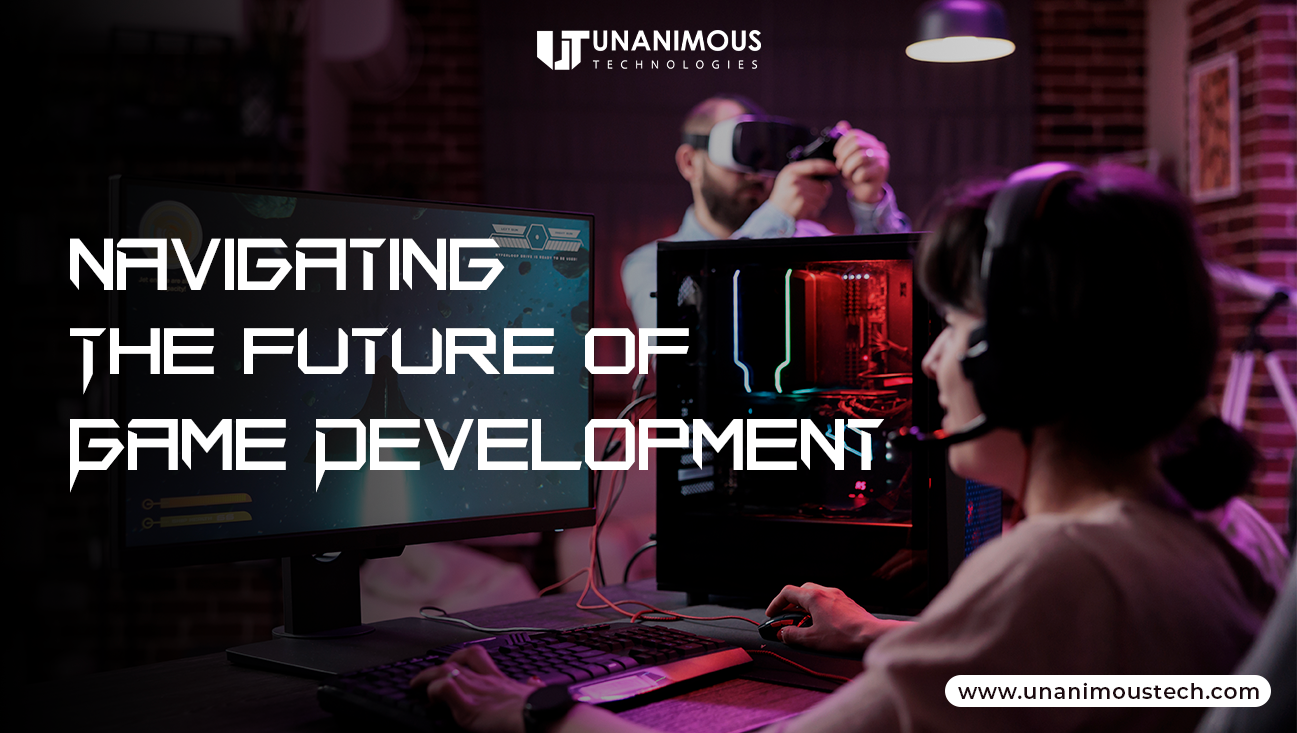
Game Development Trends 2026 are no longer just about incremental graphical updates; they represent a fundamental shift toward “Autonomous Intelligence” and “Cloud-Native Infrastructure.” At Unanimous Technologies, we believe that the gap between playing a game and inhabiting a digital reality has finally closed. As we look at the landscape of 2026, the convergence of AI, DevOps, and Spatial Computing is creating a new gold standard for the industry.
At Unanimous Technologies, we have watched this evolution from the front lines. As a firm specializing in the intersection of DevOps, AI engineering, and high-performance full-stack development, we see 2026 as the year where “Intelligence” became the primary engine of play. This deep dive explores the transformative trends that are not just changing how games look, but how they are built, deployed, and experienced.
1. How Agentic AI is Redefining Game Development Trends 2026
For decades, Non-Player Characters (NPCs) were limited by the “Dialogue Tree”—a rigid, pre-written script that players eventually exhausted. In 2026, that limitation has vanished.
From Scripted to Generative
Modern games now utilize Agentic AI. Instead of a writer scripting every possible interaction, developers at studios like Unanimous are integrating specialized Large Language Models (LLMs) directly into the game’s runtime. These models are “Lore-Grounded,” meaning they possess a deep understanding of the game world’s history but can generate responses on the fly.
The Memory Layer
The real breakthrough in 2026 is Long-Term Memory (LTM) for NPCs. Using vector databases, NPCs can now remember a player’s past actions, their tone of voice, and even their moral alignment. If you insulted a merchant in Chapter 1, that merchant might refuse to trade with you in Chapter 10—not because a flag was checked in the code, but because the NPC “remembers” the interaction and feels a generated sense of resentment.
2. Neural Graphics: Pushing the Visual Boundaries of Game Development Trends 2026
The cost of AAA game development skyrocketed in the early 2020s, largely due to the sheer number of human hours required to create 4K assets. 2026 has introduced a solution: Neural Asset Generation (NAG).
Text-to-World Pipelines
Modern engines like Unreal Engine 6 and Unity 2026 have integrated generative pipelines. Artists can now input high-level descriptions—”A post-apocalyptic Jodhpur street with sandstone textures and neon cybernetic overgrowth”—and the engine generates a base 3D environment with physically based rendering (PBR) textures in seconds.
Procedural Content Generation (PCG) 2.0
While PCG has existed for years (think No Man’s Sky), the 2026 iteration is “Semantic.” The AI understands the context of what it is building. It doesn’t just place trees randomly; it understands soil moisture, sunlight direction, and local topography to create ecosystems that feel biologically plausible. This allows small teams at Unanimous to build worlds that previously required a staff of five hundred.
3.GameOps: The DevOps Revolution in Game Development Trends 2026
As games transition into “Living Services,” the role of the DevOps engineer has become as vital as the lead programmer. At Unanimous Technologies, we call this GameOps.
Zero-Downtime Micro-Updates
In 2026, the concept of a “Server Maintenance” window is becoming obsolete. By utilizing Blue-Green Deployment strategies and containerized microservices, developers can update game logic, patch bugs, or add seasonal content without ever disconnecting the player. The game client fetches small, hot-swappable modules in the background while the user is playing.
AI-Augmented QA
Quality Assurance (QA) has traditionally been a bottleneck. Now, we deploy “Agentic Testers”—AI bots that “play” the game 24/7. These agents use reinforcement learning to find ways to break the game, discover unintended shortcuts, or identify frame-rate drops. This allows our team to ensure a “Five-Nines” (99.999%) uptime and stability for our clients’ games.
4. Cloud-Native Hybrid Rendering
The hardware barrier has finally started to crumble. In 2026, we are seeing the widespread adoption of Hybrid Rendering.
The Edge Computing Revolution
Rather than forcing a player to own a $2,000 GPU, 2026 games split the workload. The local device (your smartphone or VR headset) handles the “Latency-Sensitive” tasks like player movement and input. Meanwhile, the heavy lifting—global illumination, complex fluid physics, and high-fidelity ray tracing—is handled by Edge Servers located geographically close to the user.
For a player in Jodhpur, this means the processing might happen at a local data center, ensuring that the visual quality of a mobile game rivals that of a desktop console. This “democratization of fidelity” is a trend Unanimous Technologies is actively spearheading for our global clients.
5. Mixed Reality (MR) and Spatial Computing
While VR remains a niche, Mixed Reality (MR) has become the breakout star of Game Development Trends 2026. The launch of more affordable, room-aware glasses has shifted the focus toward “Contextual Gaming.”
Contextual Gaming
Games now use LiDAR and Room-Mapping APIs to turn your actual environment into a level. A strategy game might turn your dining table into a tactical map, while a horror game might have digital creatures “crawl” through your actual doors. This requires a sophisticated fusion of computer vision and real-time physics—areas where our full-stack expertise allows us to create seamless interactions between the digital and the physical.
6. Sustainable Development and Carbon-Aware Coding
In 2026, “Green Tech” is no longer optional. Game developers are being held accountable for the energy consumption of their server farms and the battery drain on mobile devices.
Code Optimization as a Feature
At Unanimous, we prioritize Energy-Efficient Algorithms. By optimizing shader code and reducing unnecessary network “chatter” between the client and the server, we can extend a player’s mobile battery life by up to 30%. In 2026, a “well-optimized” game is a competitive advantage, as players gravitate toward apps that don’t overheat their devices.
7. Digital Ownership: The Maturity of Web3 in Game Development Trends 2026
The “NFT” era was the “awkward teenage phase” of digital ownership. In 2026, the technology has matured into a functional Interoperable Asset system.
Sovereignty Over Digital Assets
Players can now earn an item in a fantasy RPG and, thanks to unified blockchain standards, see that item reflected as a cosmetic skin in a completely different racing game. This “Cross-Game Interoperability” is handled through transparent, background protocols. At Unanimous, we build the secure API gateways that allow these assets to move safely between different game ecosystems, ensuring that the player’s time and investment have real-world value.
8. Hyper-Personalized Experiences via Player-DNA
The trend of 2026 is the “Game that Changes for You.” Using on-device machine learning, games can now analyze a player’s “DNA”—not their biological DNA, but their Behavioral DNA.
- Adaptive Difficulty: If the game senses you are getting frustrated, the AI doesn’t just make enemies weaker; it might change the level layout to provide more cover or drop a helpful item.
- Dynamic Music: Soundtracks in 2026 are often generated in real-time. If you are playing stealthily, the music shifts to a tense, minimalist ambient track. If you go “guns blazing,” the engine procedurally generates a high-tempo orchestral score that matches the rhythm of your shots.
9. Globalization and the “Mobile-First” Mandate
As high-speed internet reaches every corner of the globe, the market is no longer dominated solely by the West. India, in particular, has become a central hub for game innovation.
Localized Intelligence
At Unanimous Technologies, we focus on Hyper-Localization. This goes beyond translating text. It involves culturally-aware AI NPCs that understand local dialects and cultural nuances. Building games for the “Next Billion Users” means designing for varied hardware, diverse languages, and local payment infrastructures like UPI, which we integrate directly into our game backends.
10. Conclusion: Why Unanimous Technologies?
As we look at the landscape of 2026, one thing is clear: the most successful games will be those that master the Fusion of Design and DevOps. You can have the most beautiful art in the world, but without a scalable AI backend and a robust cloud architecture, the experience will fail.
At Unanimous Technologies, we are uniquely positioned to navigate these trends. Our expertise in DevOps and AI Engineering ensures that your game is not just a one-off launch, but a resilient, evolving service. We understand the “plumbing” of the future—from AlloyDB deployments to LLM fine-tuning and CI/CD pipelines for Unity and Unreal.
The future of gaming is intelligent, decentralized, and infinitely scalable. It is a world where every player is the protagonist of a unique, living story.
Are you ready to architect the future of play?
Contact Unanimous Technologies today to discuss how our AI and DevOps expertise can bring your 2026 game vision to life. Let’s build something unanimous.