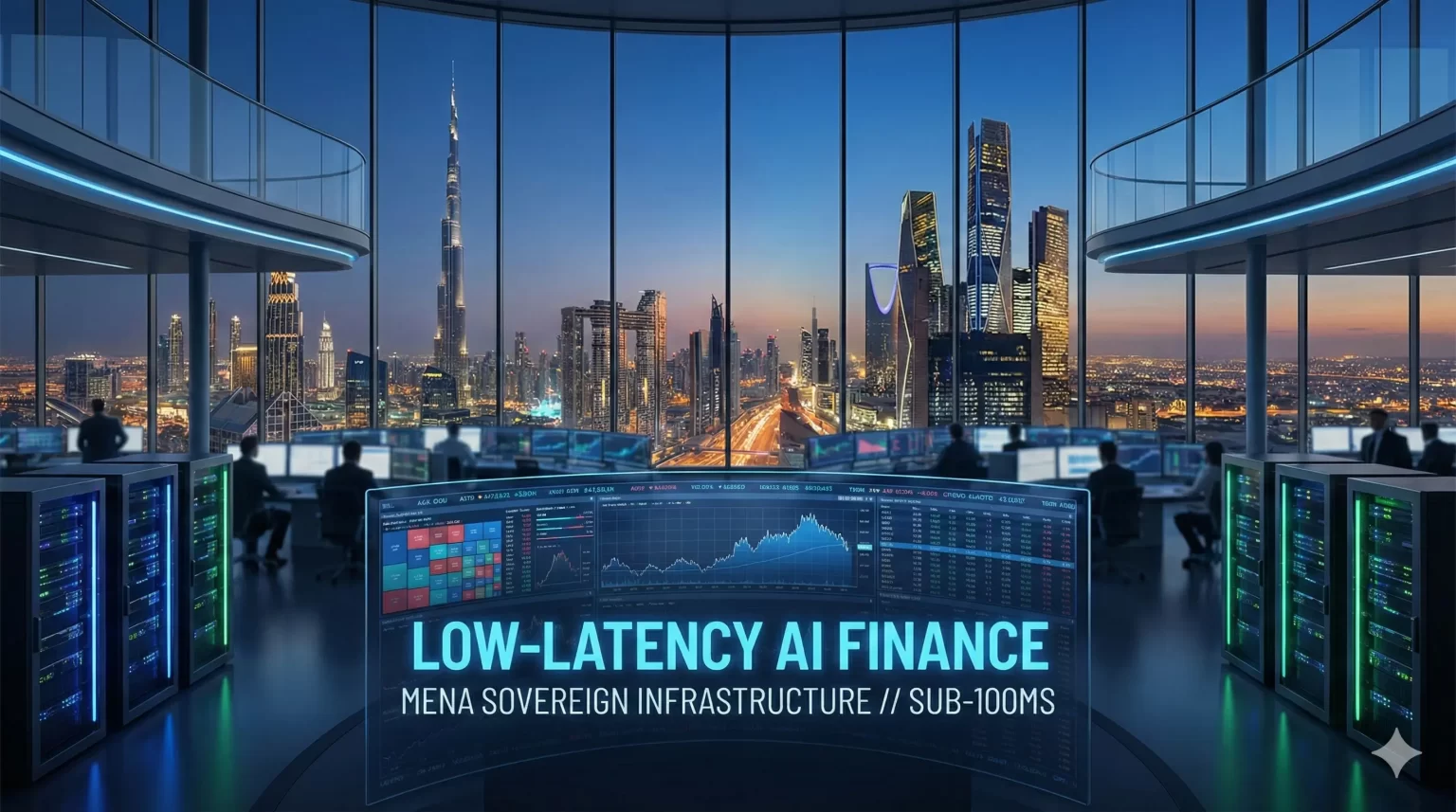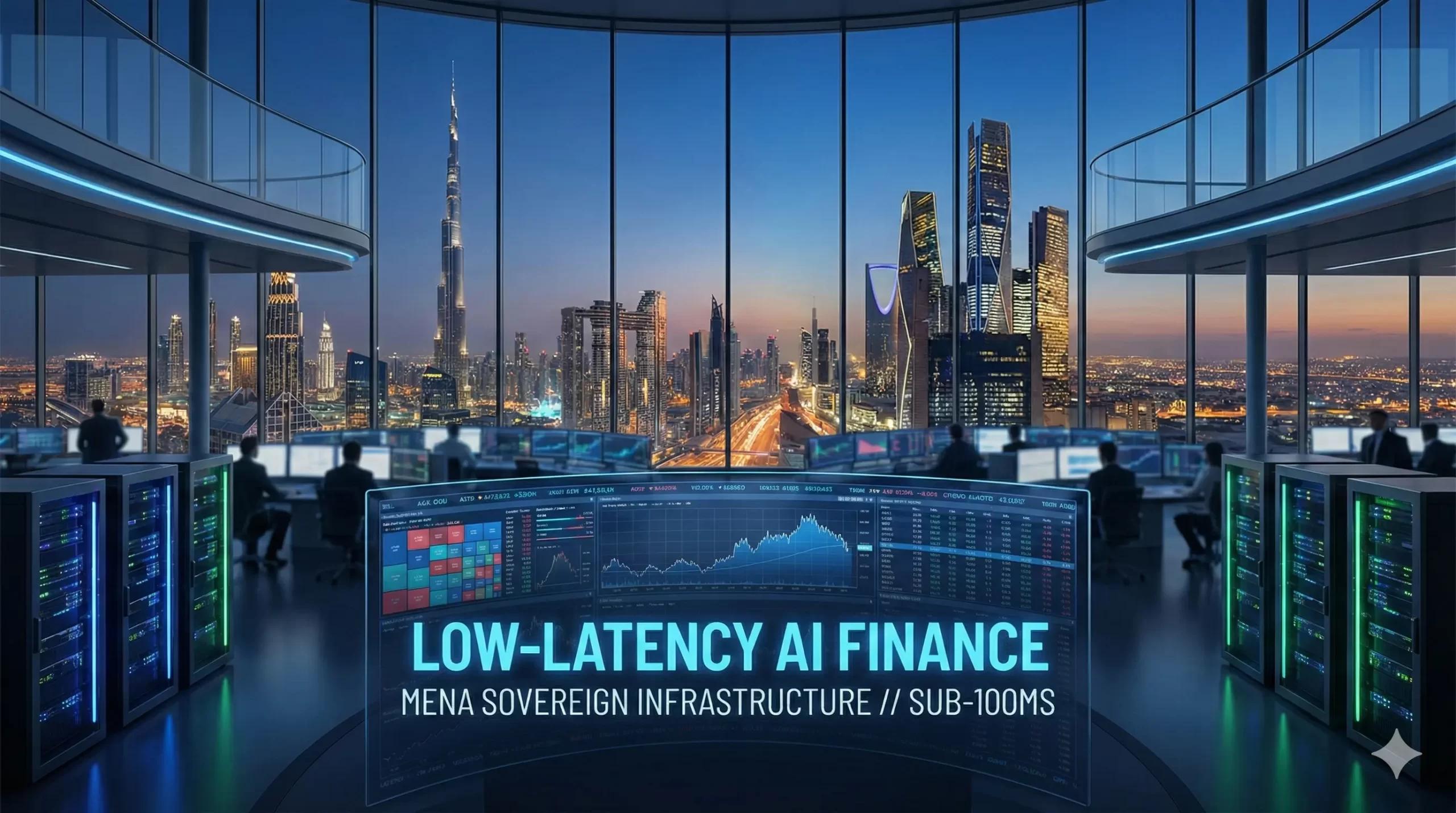
In the financial hubs of the Gulf—from the glass towers of the Dubai International Financial Centre (DIFC) to the burgeoning King Abdullah Financial District (KAFD) in Riyadh—ambition runs high. The goal is to compete with London and New York. However, to win this race, regional banks require more than just capital; they need robust Low-latency AI finance infrastructure.
To win this race, regional banks, sovereign wealth funds, and FinTech firms are aggressively adopting Artificial Intelligence. They demand AI that predicts market movements, detects fraud instantly, and hyper-personalizes banking experiences in real-time.
But there is a fatal, hidden flaw in most current AI deployments in the region.
Many institutions are building slick, modern interfaces on top of slow, generic AI “wrappers” hosted on servers thousands of miles away. In standard software, a one-second delay is an annoyance. In global finance, a one-second delay is an eternity.
In the markets, milliseconds equal millions.
If your AI is powerful but slow, it is useless for real-time finance. Today, we explore why generic AI fails the speed test, the physics behind the failure, and how Unanimous Tech engineers high-performance, low-latency AI infrastructure right here in the Gulf.
The Physics of Failure: Why “Wrapper” APIs Are Too Slow
Why can’t a Dubai bank just use standard OpenAI or Google Gemini APIs for real-time trading or fraud detection? Why can’t a Riyadh hedge fund rely on a model hosted in Virginia?
It comes down to immutable laws of physics and network topology.
When you use a standard AI wrapper, your data typically undergoes a transatlantic journey. It must travel from the Gulf to a data center usually located in the US East Coast (e.g., Northern Virginia or Ohio), be processed by an overloaded public model, and then travel all the way back.
The Math of Latency: A losing equation
This is where low-latency AI finance becomes a competitive differentiator. While competitors are stuck in the queue, an optimized system is already executing the trade. In the high-stakes environment of the Gulf, low-latency AI finance is not a luxury; it is the baseline for survival.
Let’s look at the numbers.
- Network Latency (The Round Trip): Even on fiber optics, light takes time to travel. A round trip (ping) from Dubai to the US East Coast is roughly 180-250 milliseconds (ms) under perfect conditions.
- Processing Latency (The Queue): Once the data arrives, it doesn’t get processed immediately. It sits in a queue with millions of other requests from around the world. This “inference queue” can add anywhere from 500ms to 2.5 seconds of wait time.
- Total Time: Often 0.7 to 3.0 seconds.
In the context of algorithmic trading, 3 seconds is not a delay; it is a lifetime. By the time the “insight” returns to Dubai, the market has moved. The opportunity is gone. You are trading on stale data.
Furthermore, relying on public APIs introduces variance. One request might take 800ms, the next might take 4 seconds because of high traffic in California. In financial systems, predictability is just as important as speed. You cannot build a reliable trading bot or payment gateway on infrastructure that fluctuates wildly.
The Unanimous Solution: Engineering Low-Latency AI Finance
At Unanimous Tech, we do not accept these physical limitations. We engineer AI systems designed for sub-100ms response times. We achieve this through a “Full Stack Optimization” approach, rethinking everything from the physical server location to the math inside the neural network.
1. Local Infrastructure (Beating Physics)
To achieve true low-latency AI finance, we must control the physical layer. By moving compute closer to the data source, we eliminate the speed of light limitations that plague standard models. This is the cornerstone of effective low-latency AI finance strategies.
The easiest way to reduce latency is to reduce distance. We remove the transatlantic journey entirely.
- UAE Deployment: We deploy models on-premise within the bank’s own data center or utilize local sovereign clouds like G42 or Microsoft Azure UAE North. This places the compute power within kilometers of the user.
- Saudi Arabia Deployment: We utilize the Oracle Cloud Riyadh Region or local providers compliant with SAMA (Saudi Central Bank) regulations, ensuring data never crosses borders.
The Result: Network latency drops from ~200ms to <5ms.
2. The High-Performance Stack (FastAPI & Rust)
Many data science teams build prototypes in Python using standard frameworks like Flask or Django. While excellent for websites, these are often too slow for high-frequency inference.
- FastAPI for Microservices: We utilize FastAPI for our Python microservices. Built on Starlette and Pydantic, it offers one of the fastest benchmarks for Python frameworks available today, enabling asynchronous non-blocking code execution.
- Rust for Bottlenecks: For the absolute most critical paths—such as the “matching engine” in a trading bot or the pre-processing layer of a fraud detector—we rewrite the code in Rust. Rust provides memory safety without a garbage collector, meaning there are no random “pauses” in processing. It allows us to process data at the speed of C++, shaving crucial milliseconds off every request.
3. Model Optimization (The Secret Weapon: NVIDIA TensorRT)
This is where true engineering comes into play. We don’t run raw, bulky AI models. We “compile” them.
Most AI models are trained using 32-bit floating-point precision (FP32). This provides high accuracy but is computationally heavy. For inference, however, you rarely need that level of precision.
- Quantization: We use tools to convert the model from FP32 to FP16 (half-precision) or even INT8 (8-bit integer). This reduces the model size by 4x and increases speed significantly, often with less than 1% loss in accuracy.
- Layer Fusion with TensorRT: We use NVIDIA TensorRT to fuse layers of the neural network. Instead of the GPU calculating Layer A, saving it to memory, then reading it back for Layer B, TensorRT fuses them into a single kernel calculation. This reduces memory bandwidth usage—the most common bottleneck in modern AI.
The Result: Inference (the AI’s “thinking” time) is sped up by 2x to 5x compared to standard deployments.
Regulatory Velocity: Why Compliance Equals Speed
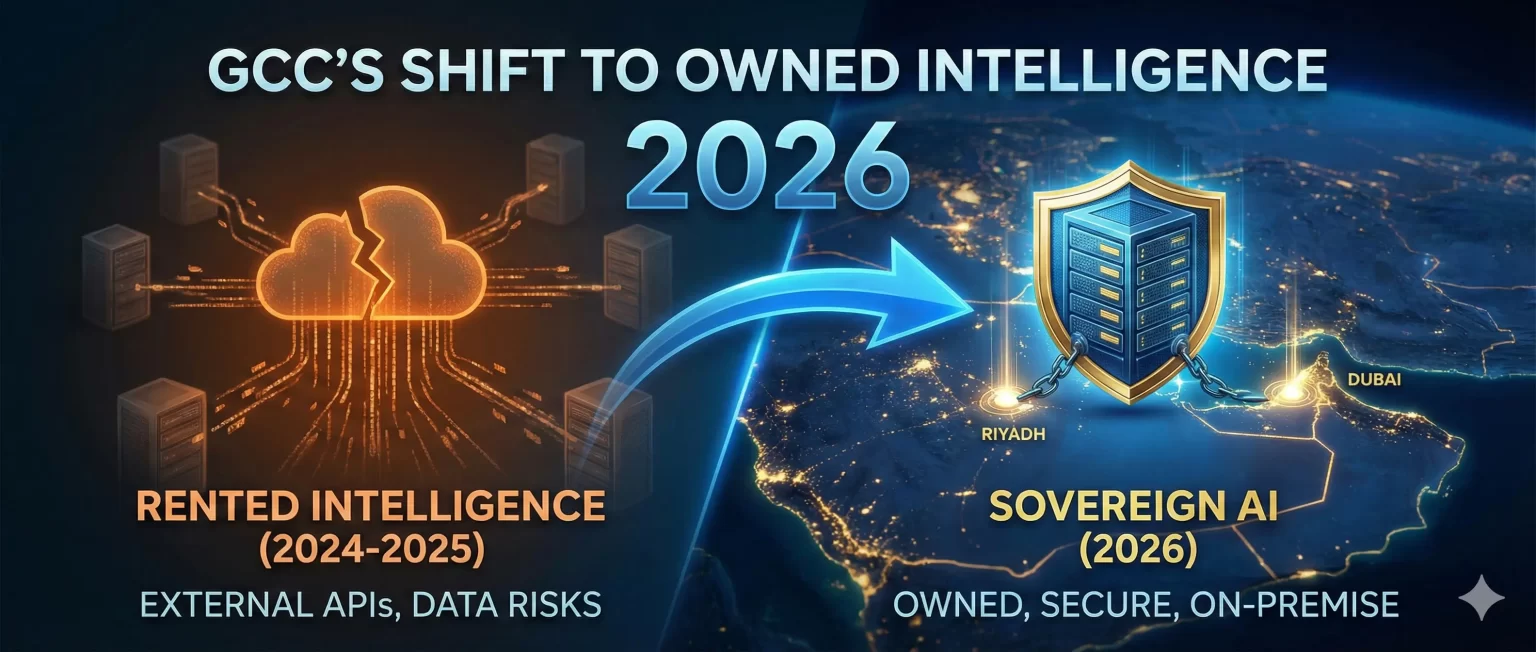
In the MENA region, “Sovereign AI” is often discussed as a compliance burden. At Unanimous Tech, we view it as a performance accelerator. The regulations enforcing data localization actually force architects to build faster systems.
Saudi Arabia: SAMA & ECC-2 Compliance
The Saudi Central Bank (SAMA) has implemented strict guidelines under the Cybersecurity Framework and the Essential Cybersecurity Controls (ECC-2). These mandates require financial institutions to host sensitive data within the Kingdom.
- The Latency Advantage: By legally mandating that data cannot travel to Virginia or Frankfurt, SAMA inadvertently mandates low-latency architecture. When your AI model lives in a Riyadh data center to satisfy ECC-2, your customers in Jeddah enjoy lightning-fast responses.
DIFC: Regulation 10 & The Autonomous Systems Officer
The Dubai International Financial Centre (DIFC) recently introduced Regulation 10 under its Data Protection Law. This groundbreaking rule requires entities using high-risk AI to appoint an “Autonomous Systems Officer” and ensure human oversight.
- The Governance Advantage: Local, transparent models are easier to audit than “black box” APIs abroad. By hosting locally, you not only gain speed but also full visibility into the model’s decision-making process, satisfying the DIFC’s transparency requirements.
Critical MENA FinTech Use Cases Where does this extra speed actually matter in the Gulf market? Low-latency AI finance isn’t just about bragging rights; it is about core business functionality.
Where does this extra speed actually matter in the Gulf market? It isn’t just about bragging rights; it is about core business functionality.
Use Case 1: Algorithmic & High-Frequency Trading (DIFC/ADGM)
Hedge funds and family offices in Dubai are increasingly looking at AI-driven trading strategies (Quantitative Analysis).
- The Slow Way: An AI analyzes news sentiment in the US and sends a “Buy” signal to Dubai 1 second later. By then, other bots co-located at the exchange have already executed the trade, driving the price up. You buy at the top.
- The Unanimous Way: An optimized, locally hosted model sits on a server right next to the exchange matching engine (Colocation). It analyzes real-time data feeds and executes trades in microseconds, capturing “Alpha” before competitors react.
Use Case 2: Real-Time Payment Fraud Detection
Saudi Arabia and the UAE are rapidly moving toward cashless societies (Vision 2030). When a customer taps their card at a coffee shop in Riyadh, the payment processor has a hard time limit—usually under 200 milliseconds—to approve or decline the transaction.
For modern banking, low-latency AI finance is essential for customer experience. A fraud check that takes seconds will lose customers. Implementing low-latency AI finance protocols ensures that security never comes at the cost of speed.
- The Slow Way: The transaction data is sent to a cloud AI for fraud checking. It takes 1.5 seconds to return. The point-of-sale machine times out, the transaction fails, and the customer gets frustrated.
- The Unanimous Way: A highly specialized “Fraud Scoring” model sits on the bank’s local edge server. It receives the transaction data, runs 50+ risk checks (geolocation, spending pattern, velocity) in under 50ms, and returns a verdict instantly. The customer experience is seamless, and fraud is blocked at the gate.
Use Case 3: Sovereign RAG for Wealth Management
Banks want to move from “service” to “advisory.” They possess millions of private PDF documents—investment reports, tax filings, and market analyses—that they cannot upload to public ChatGPT due to privacy laws.
- The Slow Way: Analysts manually search through PDFs, taking hours to answer client queries.
- The Unanimous Way: We deploy a Local RAG (Retrieval-Augmented Generation) system. We index the bank’s secure documents into a local vector database. When a wealth manager asks, “What is our exposure to Asian tech stocks?”, the local AI retrieves the exact paragraphs and generates a summary in seconds, without a single byte leaving the bank’s firewall.
Future-Proofing: The Edge and Beyond
The race doesn’t stop at low latency. The next frontier in MENA finance is Edge AI.
We are currently exploring the deployment of quantized Small Language Models (SLMs) directly onto POS terminals and mobile devices. Imagine a banking app that can categorize expenses and offer financial advice even when the user is offline, processing data directly on the phone’s NPU (Neural Processing Unit).
Furthermore, with the rise of Groq LPUs (Language Processing Units) and Cerebras wafer-scale engines—technologies currently being integrated into Saudi’s digital ecosystem via partnerships like Aramco Digital—the definition of “fast” is about to change again. Unanimous Tech is actively testing these architectures to ensure our clients are ready for the next leap in speed.
Conclusion: Don’t Bring a Sedan to an F1 Race
The financial ambitions of the Gulf are world-class. The infrastructure powering those ambitions must match.
If your institution is relying on generic, high-latency AI APIs for mission-critical financial operations, you are bringing a consumer sedan to a Formula 1 race. You might eventually get around the track, but you won’t win. To dominate in FinTech, you need engineering rigor. You need optimized models, local deployment, and blazing-fast architecture.
Unanimous Tech is the pit crew for high-performance financial AI in the MENA region. We don’t just build AI that thinks; we build AI that thinks fast.
Ready to accelerate your AI infrastructure?
Contact the Unanimous Tech Engineering Team today for a latency audit.
Frequently Asked Questions (FAQ)
Why is low latency important for AI in finance?
In finance, market conditions change in milliseconds. High latency (slow speed) means your AI is making decisions based on old data. For trading, this leads to financial loss (slippage). For payments, it leads to transaction timeouts and frustrated customers.
How does Unanimous Tech achieve sub-100ms latency?
We use a three-pronged approach:
- Local Hosting: We deploy models in UAE/KSA data centers to minimize network travel time.
- TensorRT Optimization: We compile AI models to run efficiently on NVIDIA GPUs.
- Quantization: We compress models to INT8 precision to speed up calculation without losing accuracy.
Is local AI deployment compliant with SAMA and DIFC regulations?
Yes. Local deployment is the most compliant method. SAMA’s ECC-2 and DIFC’s Data Protection Law emphasize data residency. By keeping data within the country’s borders, you automatically satisfy the strictest sovereignty requirements while gaining performance benefits.
Can we use Large Language Models (LLMs) locally?
Yes. We deploy open-weights models (like Llama 3 or Mistral) that rival GPT-4 in performance but are hosted entirely on your own secure servers. We optimize these using TensorRT-LLM to ensure they run fast enough for real-time customer service or document analysis.