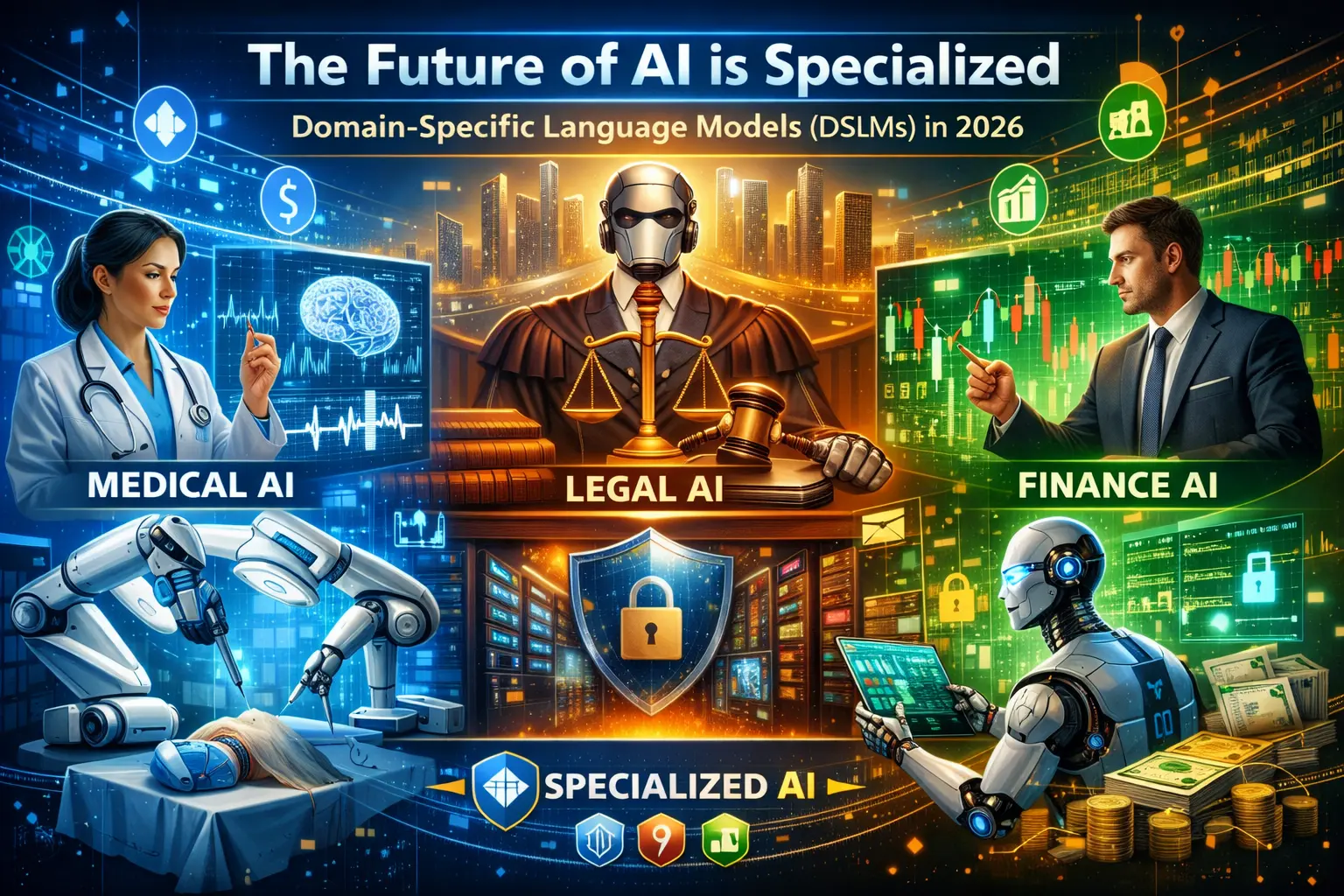
Domain-Specific Language Models (DSLMs) are rapidly becoming the gold standard for enterprise intelligence as we move through 2026. While general-purpose AI once dominated the conversation, the “Jack-of-all-trades” approach is hitting a ceiling in professional environments where precision is non-negotiable. At Unanimous Technologies, we are seeing this evolution firsthand: the shift from broad horizontal AI to vertical, expert-driven depth.
While general Large Language Models (LLMs) provide a broad layer of intelligence, Domain-Specific Language Models (DSLMs) offer the specialized depth required for high-stakes industries. They are the neurosurgeons and tax attorneys of the artificial intelligence world. For enterprises today, the goal is no longer just “using AI”—it is “using AI that actually understands the nuances of my business.”
1. What is a Domain-Specific Language Model (DSLM)?
A Domain-Specific Language Model (DSLM) is a generative AI system trained or refined on a specialized corpus of data relevant to a particular industry, profession, or academic field.
Unlike general LLMs, which are trained on “Common Crawl” data, a DSLM‘s “brain” is built on high-authority, niche data. For organizations partnering with Unanimous Technologies, building a DSLM means moving away from generic responses and toward expert-level accuracy.
The data fueling a Domain-Specific Language Model (DSLM) usually includes:
- Medical DSLMs: PubMed papers, clinical trial results, and EHR patterns.
- Legal DSLMs: Case law, statutes, and constitutional precedents.
- Financial DSLMs: SEC filings, real-time market tickers, and historical volatility data.
2. Why General LLMs Fail in High-Stakes Industries
The limitations of general-purpose models in professional settings are becoming more apparent. To understand why Domain-Specific Language Models (DSLMs) are winning, we must look at the three “Critical Failures” of generalist AI:
A. The Vocabulary Gap
Language is fluid. In a general context, the word “yield” might refer to a harvest. In a financial DSLM, it refers to investment earnings. Domain-Specific Language Models (DSLMs) eliminate the ambiguity that plagues generalist models.
B. The Hallucination Liability
In a $50 million merger agreement, a “hallucinated” clause is a catastrophic risk. A Domain-Specific Language Model (DSLM) reduces this error by grounding the model in a closed loop of verified industry data.
C. Data Privacy and Sovereignty
Most general LLMs operate in the public cloud. However, a Domain-Specific Language Model (DSLM) can be hosted on private servers, keeping proprietary data behind a firewall—a core service we provide at Unanimous Technologies.
3. The Architecture of Expertise: How DSLMs are Built
Building a Domain-Specific Language Model (DSLM) is a surgical process. There are three primary technical pathways to creating these specialized experts.
I. Continual Pre-training for DSLM Development
This involves taking a base model and exposing it to hundreds of billions of tokens of industry text. This “Domain Adaptation” ensures the DSLM prioritizes industry-specific logic over general internet slang.
II. Fine-Tuning Your DSLM
Fine-tuning is a targeted approach. Developers use “Question-Answer” pairs curated by human experts to ensure the Domain-Specific Language Model (DSLM) follows professional protocols.
III. RAG (Retrieval-Augmented Generation) and the DSLM
RAG is the most efficient way to deploy a DSLM. By connecting the model to a live database, the Domain-Specific Language Model (DSLM) can cite specific internal documents in real-time.
4. Sector-Specific Use Cases
To see the power of Domain-Specific Language Models (DSLMs), we must look at them in action across the 2026 economic landscape.
Healthcare: The DSLM Clinical Co-Pilot
Modern healthcare DSLMs act as diagnostic support. By analyzing a patient’s history against the latest oncology journals, a medical DSLM can flag rare drug interactions that a general AI would overlook.
Legal Tech: DSLMs and Discovery
In the legal world, a Domain-Specific Language Model (DSLM) can scan 10,000 documents to find a specific instance of “breach of fiduciary duty” in seconds. The DSLM understands the legal weight of every word.
Cybersecurity: Threat Hunting with a DSLM
A Cybersecurity DSLM can identify a “Zero-Day” vulnerability in a proprietary codebase. It is trained on network logs, making the DSLM far more effective than a general-purpose chatbot.
5. The Economic Impact: ROI of Specialization
Is it cheaper to use a general model or build a DSLM? While the upfront cost of a Domain-Specific Language Model (DSLM) is higher, the long-term ROI is found in lower inference costs and higher accuracy.
| Metric | General LLM | Domain-Specific Language Model (DSLM) |
| Accuracy (Niche) | 65-75% | 95%+ |
| Inference Cost | High | Low (Optimized DSLM) |
| Expertise | Generalist | Specialist DSLM |
6. Challenges in the DSLM Ecosystem
Despite their brilliance, Domain-Specific Language Models (DSLMs) are not a “set it and forget it” solution.
- Data Quality: A DSLM is only as good as the data fed into it.
- Maintenance: As industries evolve, your Domain-Specific Language Model (DSLM) must be updated to reflect new laws or research.
7. Future Trends: Toward “Liquid” DSLMs
As we look toward 2027 and beyond, the next evolution is the Agentic DSLM. These aren’t just models that talk; they are models that do. A finance DSLM won’t just analyze a report; it will execute a hedge strategy across multiple exchanges autonomously.
We are also seeing the rise of “Federated Learning” for DSLMs. This allows multiple hospitals to train a shared medical model without ever sharing their actual patient data with each other—a breakthrough for privacy-preserving AI.
8. Summary: Why You Need a DSLM Strategy Today
The transition from general AI to Domain-Specific Language Models (DSLMs) represents the professionalization of the AI industry. For businesses, the competitive advantage comes from owning the data-moat that makes your DSLM smarter than the competition.
At Unanimous Technologies, we believe the next wave of innovation belongs to the Domain-Specific Language Model (DSLM).
Key Takeaways for Decision Makers:
- Stop chasing “Large”: Focus on “Precise.” A 7B model that knows your business is better than a 1T model that knows everything about nothing.
- Invest in Data Hygiene: Your DSLM is only as good as the documents you feed it.
- Prioritize RAG first: Before training a model from scratch, try the Retrieval-Augmented Generation approach to see immediate ROI
Ready to Build Your Industry’s “Digital Brain”?
The shift to a Domain-Specific Language Model (DSLM) requires precision engineering. At Unanimous Technologies, we specialize in the DevOps and AI architecture needed to deploy a high-performing DSLM.
Whether you need a RAG-based DSLM or a fully fine-tuned Domain-Specific Language Model, our team is ready to help.
Schedule a Strategic DSLM Consultation with Unanimous Technologies