Introduction: The Death of Static Automation
In 2026, the traditional DevOps handbook has been rewritten. For the past decade, we relied on Infrastructure as Code (IaC) and deterministic CI/CD pipelines. While these tools brought consistency, they remained “dumb”—they could only follow the exact scripts humans wrote. When a production environment drifted or a zero-day vulnerability appeared at 3:00 AM, the system waited for a human to wake up.
Agentic DevOps marks the transition from automation to autonomy. At Unanimous Technologies, we are leading this shift, moving beyond “Human-in-the-Loop” systems toward “Human-on-the-Loop” architectures. Here, AI agents don’t just execute tasks; they reason through complexity, perceive system health, and act decisively to maintain uptime.
What is Agentic DevOps? Defining the Autonomous SDLC
Agentic DevOps is the integration of LLM-based Autonomous Agents into the Software Development Lifecycle (SDLC). Unlike standard AIOps—which simply alerts you when something is wrong—Agentic AI possesses a “Reasoning Engine.”
The Three Pillars of Agentic Capability:
- Perception (Observability 2.0): Agents ingest multi-modal data—structured metrics from Prometheus, unstructured logs from ELK, and distributed traces—to build a semantic understanding of system state.
- Reasoning (Root Cause Analysis): When a latency spike occurs, the agent doesn’t just see the spike; it correlates it with a recent Git commit, analyzes the diff, and identifies a recursive function causing a memory leak.
- Action (Self-Correction): The agent autonomously generates a fix, creates a branch, runs the test suite in a sandbox, and—upon passing—executes a canary deployment to resolve the issue.
The Role of AI Agents: Your New “Synthetic Engineers”
At Unanimous Technologies, we view these agents as Synthetic Engineers. They serve as tireless teammates that handle the “toil” of modern cloud-native environments.
1. The SRE Agent (Site Reliability)
The SRE Agent is the guardian of the “Five Nines.” In 2026, these agents manage Kubernetes clusters with predictive precision. If a pod crashes, the agent cordons the node, analyzes the heap dump, and scales the horizontal pod autoscaler (HPA) based on predicted traffic bursts rather than static thresholds.
2. The DevSecOps Agent (Security)
Security is no longer a gate; it is a continuous, autonomous process. These agents scan for CVEs (Common Vulnerabilities and Exposures) in real-time. If a high-severity patch is released for a container image, the agent automatically opens a Pull Request (PR) with the updated version, verified by your internal security policy.
3. The FinOps Agent (Cost Optimization)
Cloud waste is the silent killer of margins. FinOps agents at Unanimous Technologies continuously monitor AWS, Azure, and GCP spend. They identify orphaned volumes, underutilized instances, and suggest—or execute—spot instance migrations to save up to 40% on monthly cloud bills.
Key Trends Driving the Agentic Revolution in 2026
Self-Healing Infrastructure
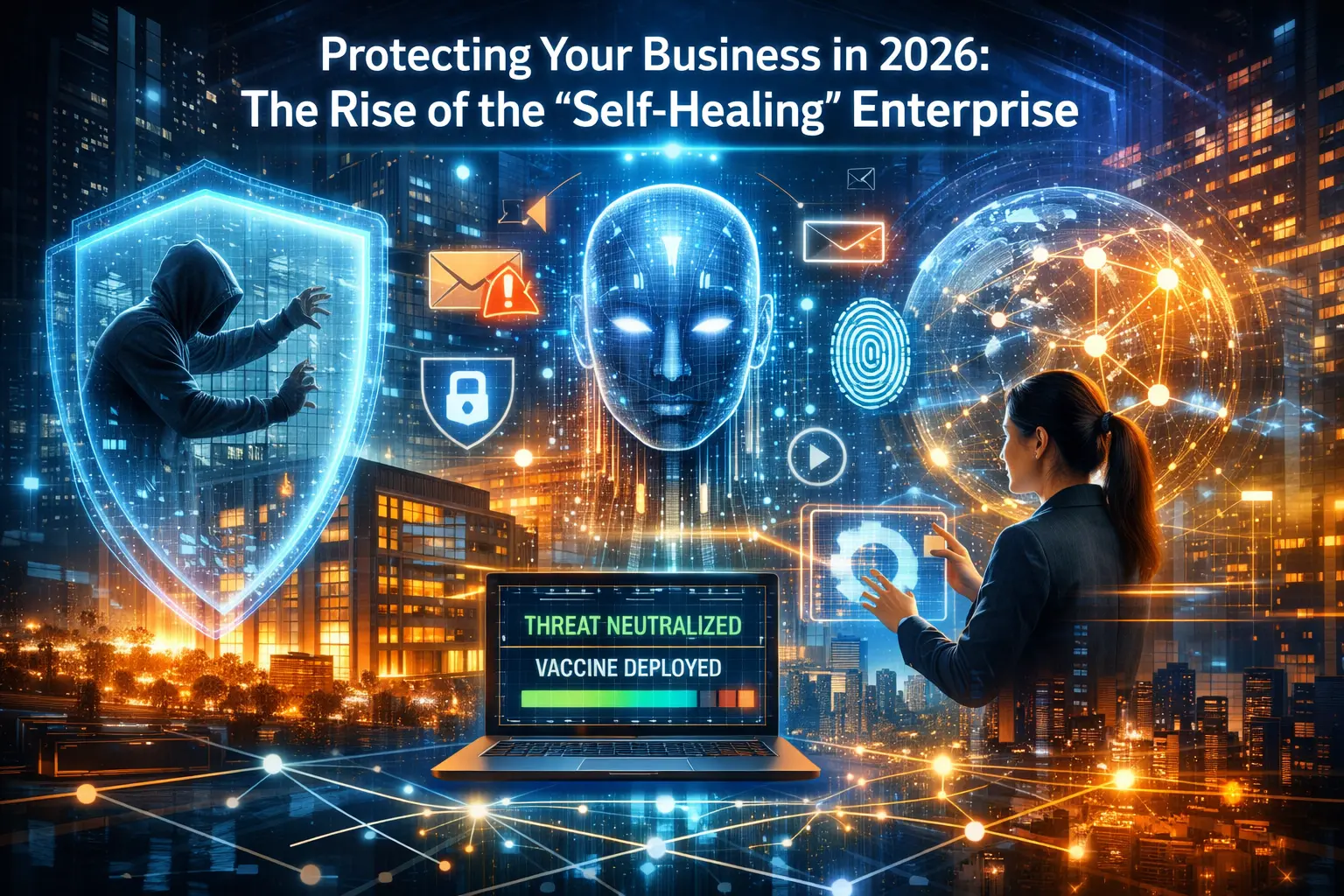
The “Holy Grail” of IT operations is no longer a myth. In the Agentic era, infrastructure is self-aware. We utilize Multi-Agent Systems (MAS) where a “Monitoring Agent” communicates with a “Provisioning Agent” to swap out failing hardware or roll back buggy deployments without a single human keystroke.
Intent-Based Provisioning
Stop writing 500-line YAML files. In 2026, Unanimous Technologies enables engineers to use Natural Language Intent.
- Engineer Intent: “Deploy a high-availability, PCI-compliant PostgreSQL cluster in the ME-South region with 15-minute backup intervals.”
- Agent Action: The agent generates the Terraform code, ensures compliance with regional data sovereignty laws , and triggers the pipeline.
Agentic DevOps vs. Traditional DevOps: The Comparison
To understand the ROI, we must look at the fundamental differences in operations:
| Feature | Traditional DevOps (2020-2024) | Agentic DevOps (2026+) |
| Automation Model | Deterministic (Static Scripts) | Probabilistic (Reasoning Agents) |
| Incident Response | Manual / Playbook-driven | Autonomous Self-Healing |
| Scalability | Reactive (Threshold-based) | Predictive (Data-driven) |
| Security | Periodic/Scheduled Scans | Continuous Autonomous Patching |
| Cloud Governance | Manual Tagging & Audits | Real-time Agentic Enforcement |
Implementing Agentic DevOps: The Unanimous Technologies Framework
Moving to an autonomous model is a journey, not a switch. We help organizations transition through a structured three-tier approach:
Phase 1: The Observability Audit
Before an agent can act, it must see. We overhaul your CI/CD and monitoring stack to ensure data is “Agent-Ready.” This involves moving to OpenTelemetry standards and ensuring logs are semantically rich.
Phase 2: Bounded Autonomy & Guardrails
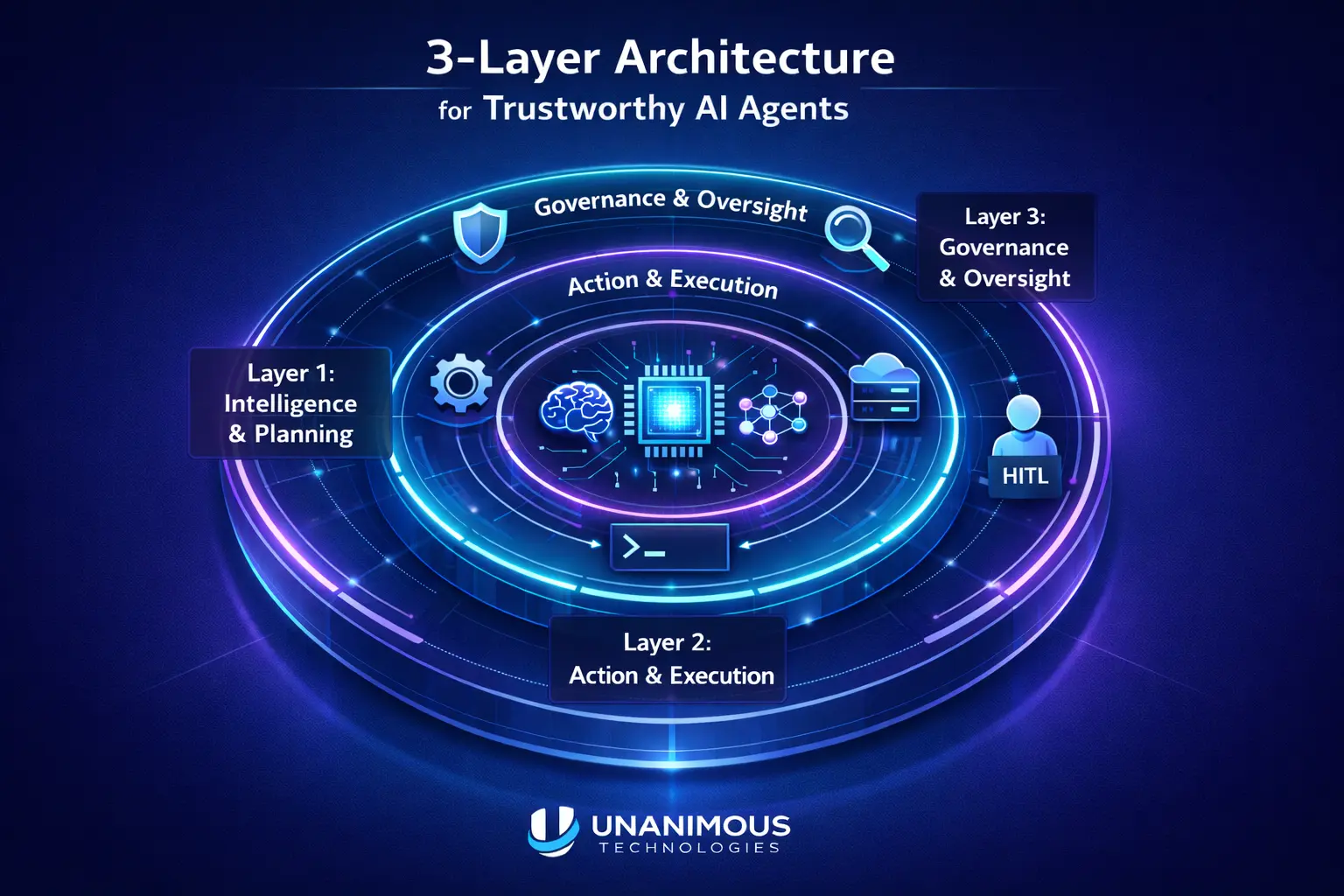
Trust is built through guardrails. We implement Policy-as-Code (PaC) using tools like Open Policy Agent (OPA). This ensures that while an agent has the “agency” to act, it cannot exceed budget limits or delete critical production databases without human “Human-in-the-Loop” approval for high-stakes actions.
Phase 3: Multi-Agent Orchestration
We deploy specialized agents that collaborate. A “Security Agent” might suggest a patch, but a “Performance Agent” might delay it until a low-traffic window is identified. This orchestration mimics a high-functioning human engineering team.
Conclusion: Empowering the Platform Architect
The era of “clicking buttons” in a console is over. Agentic DevOps isn’t about replacing engineers; it’s about elevating them. By offloading the repetitive, soul-crushing tasks of patching and scaling to AI, your engineers become Platform Architects. They focus on high-level strategy, business logic, and innovation.
Ready to modernize your infrastructure?
At Unanimous Technologies, we specialize in the intersection of DevOps and Agentic AI. Let’s build an autonomous future together.
FAQ: Navigating the Autonomous Frontier
Q: Is Agentic DevOps safe for production environments?
A: Yes, when implemented with Bounded Autonomy. We utilize a “Sandbox-First” approach where agents must prove a fix in a twin environment before touching production.
Q: How does this impact our SEO and digital presence?
A: In 2026, AI-driven search engines (AEO – Answer Engine Optimization) prioritize “Technical Authority.” By publishing deep-dives on Autonomous Infrastructure and Agentic AI, Unanimous Technologies positions itself as a thought leader, capturing high-intent enterprise traffic.
Q: Can these agents work with legacy “Clean Code” standards?
A: Absolutely. Our agents are trained on modern “Clean Code” principles. They don’t just fix bugs; they refactor legacy code to meet 2026 standards, reducing technical debt autonomously.