The technological landscape is undergoing a tectonic shift. For decades, software design operated under a foundational paradigm: humans provide instructions, and machines execute them precisely within fixed parameters. Even the early waves of artificial intelligence operated primarily within this framework. For years, we have been accustomed to AI as a tool—a sophisticated assistant that suggests words, summarizes long documents, or generates images upon request.
But we are now moving into an era where AI is no longer just a passive participant; it is becoming an active agent. The rise of AI agents in modern applications represents the next frontier of digital transformation, promising to redefine how businesses operate and how users interact with software. Instead of users navigating dense user interfaces to pull data or trigger isolated features, software architectures are evolving into fluid ecosystems driven by autonomous intent. This comprehensive deep dive explores what AI agents are, how they are reshaping industry applications, the fundamental shifts in engineering workflows, the architectural challenges developers face, and how Unanimous Technologies can guide your enterprise through this transformative shift.
What is an AI Agent?
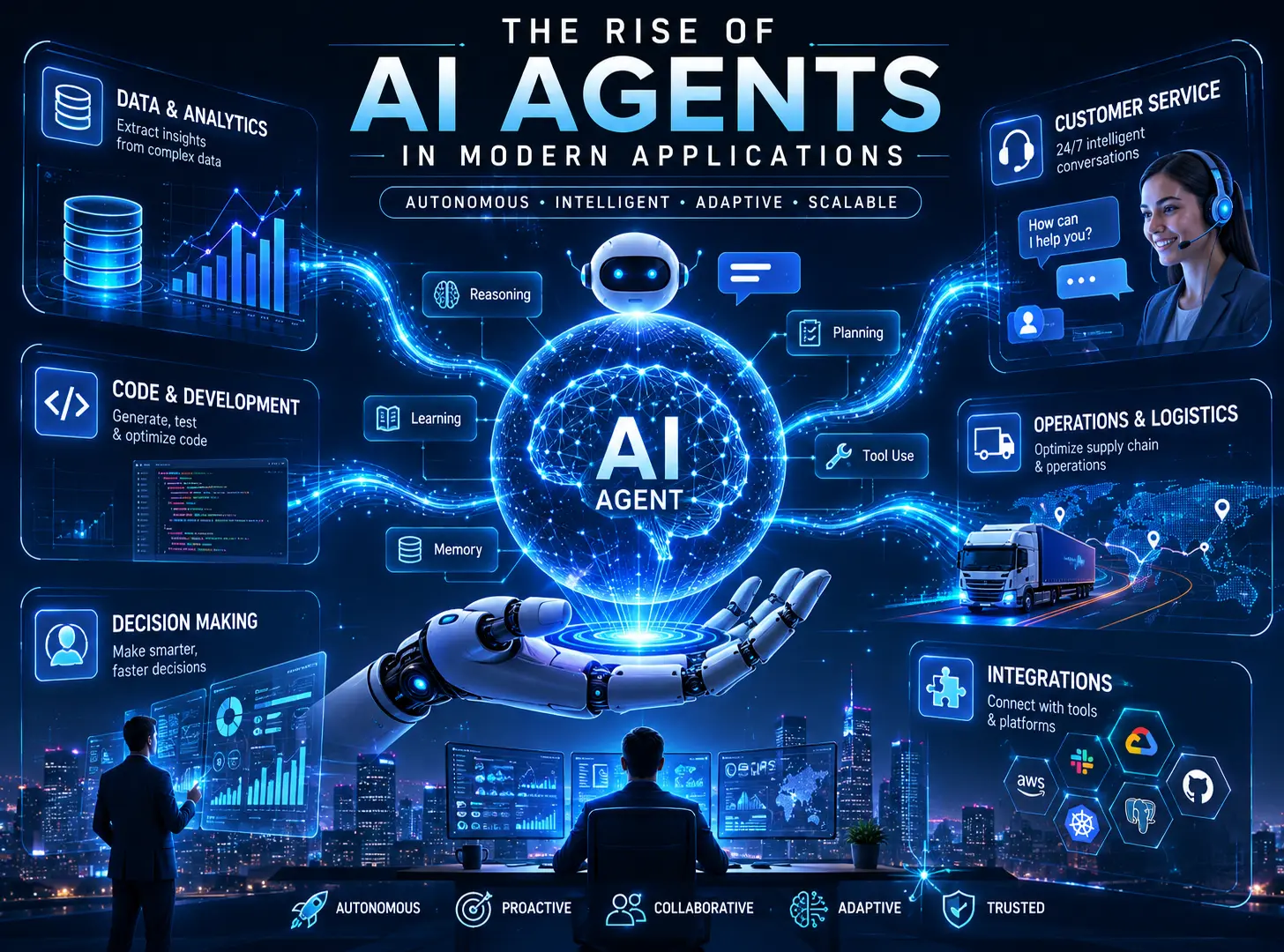
To understand the shift, we must first define the difference between a traditional Large Language Model (LLM) and an AI Agent. While a standard LLM acts as a conversational interface—receiving input and generating text—an AI Agent is a system designed to perform tasks autonomously.
An LLM on its own is a statistical marvel, mapping patterns in text to provide answers to prompts. However, it lacks state memory across different tools, cannot change its own behavior based on the results of an action, and cannot independently decide to call a third-party application. Conversely, an AI Agent wraps an intelligence core (such as an LLM) inside a systematic framework capable of executing complex loops.
An AI Agent possesses three core capabilities:
- Perception: The ability to understand the environment and user intent. This goes beyond parsing text to interpreting multi-modal inputs, system logs, environmental state variables, and real-time streams of business data.
- Reasoning: The capacity to break down complex goals into actionable sub-tasks. The agent evaluates its progress, determines whether a specific strategy is working, and dynamically adjusts its planning loop when unexpected obstacles occur.
- Action: The ability to interact with external tools, APIs, and software applications to achieve a desired outcome. Rather than simply writing code, it executes code; rather than explaining a database change, it writes and fires the SQL script safely.
Think of an LLM as a highly intelligent encyclopedia that you must query, while an AI Agent is a personal assistant that you can task with a project. You don’t just ask the agent for information; you ask it to “book a flight that fits within this budget and updates my calendar”. The agent processes that high-level abstract directive, explores options, checks external calendar states, makes decisions based on implicit constraints, executes API calls to a booking portal, and returns a verified completion summary.
The Evolution: From Chatbots to Autonomy
The current state of automation did not appear overnight. It is the result of a steady progression across software development paradigms. Understanding this evolutionary path helps place the significance of modern agentic workflows in context.
Phase 1: Hardcoded Rules and Static Systems
Before the advent of generative models, software automation was explicitly programmed. If-then statements dictated every pathway. While highly secure and predictable, these systems were completely brittle. A single variance in input format or an unmapped user edge case would break the entire automation pipeline.
Phase 2: Simple Integrations and Chatbots
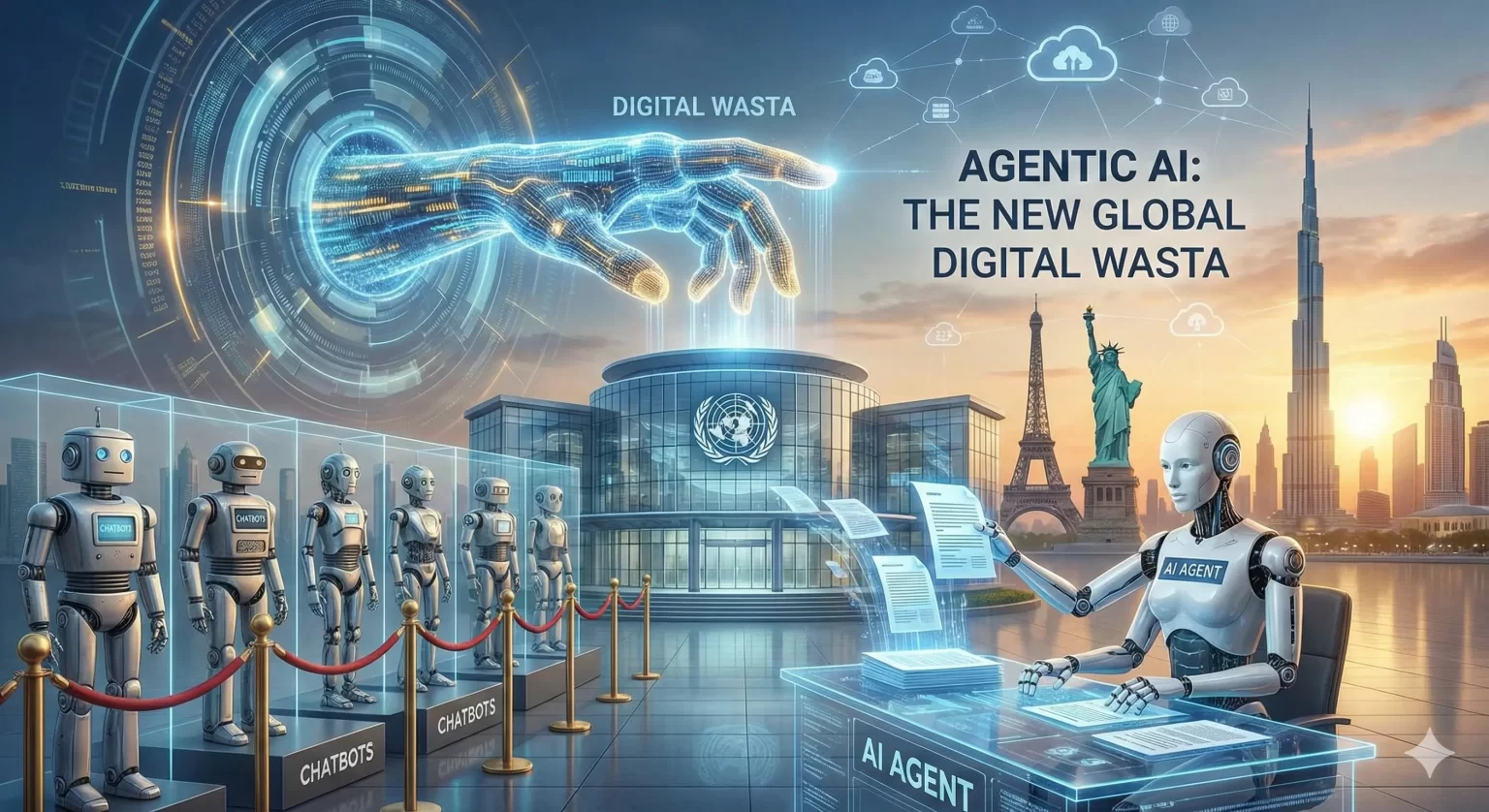
In the early days of generative AI, integration meant simple API calls—sending a prompt and receiving a response. These “Chatbot” experiences were helpful but inherently limited by their inability to execute actions beyond the chat window. Users had to read the output of the chatbot and manually copy-paste or execute the recommended step in another program. The model could give advice, but it couldn’t pull the levers of production.
Phase 3: The Dawn of Agentic Workflows
The current paradigm shift is fueled by Agentic Workflows. Developers are now embedding “tool-use” capabilities (often called Function Calling) into AI systems. By giving agents access to browser automation, database queries, and enterprise software (CRM, ERP, Slack), we enable them to complete end-to-end workflows that previously required a human in the loop for every step. This evolutionary step moves the core interface from natural language generation to natural language orchestration.
Why AI Agents are Transforming Modern Applications
The rapid adoption of agentic architectures is driven by fundamental improvements in business efficiency, user experience, and operational scalability. Here are three primary reasons why agents are reshaping the digital landscape:
1. Shift from Task-Oriented to Goal-Oriented Interactions
Traditional software is rigid; users must navigate complex UIs to achieve a goal. Users spend hours learning where specific buttons sit inside enterprise dashboards, clicking through sub-menus, and validating forms.
AI agents flip this model entirely. Instead of the user figuring out the interface, the agent figures out how to use the interface to meet the user’s goal. This dramatically lowers the friction for complex digital operations. The user describes the desired business end-state—such as “Generate a monthly compliance report by matching our AWS logs with our internal security ledger”—and the agent creates and executes the step-by-step procedure needed to compile the data.
2. Cross-Application Connectivity
Modern enterprise environments are deeply fragmented. Important data lives across dozens of isolated systems: customer data lives in Salesforce, communication happens in Slack, product design updates sit in Figma, and engineering tasks are tracked in Jira. Historically, syncing these platforms required massive, expensive custom integration pipelines or tedious human labor.
AI agents serve as the “connective tissue” between these software silos. They can synthesize information across disparate platforms, essentially acting as a universal API that speaks in natural language. An agent can monitor a Slack channel for customer complaints, automatically verify the customer’s history in Salesforce, look up relevant bug files in Jira, draft a technical explanation, and open an internal review ticket—all within seconds.
3. Hyper-Personalization at Scale
Standard software applications treat every user relatively the same, offering a static set of features. Because agents can maintain context, memory, and analytical logs over time, they learn user preferences and unique operational habits.
Over time, an agent doesn’t just perform a task—it performs it the way you would prefer, preemptively adjusting to your unique workflow requirements. If an executive consistently rejects reports that lack a specific financial breakdown, the agent notes this feedback in its vector database memory and adjusts its future reasoning loops to include that breakdown implicitly.
Key Sectors Leading the Agentic Revolution
The transition to autonomous workflows is visible across multiple major sectors, completely redefining old operational models.
| Sector | Legacy Approach | Agentic Approach |
| Customer Support | Static tickets, long queues, basic script response | End-to-end issue resolution, automated refunds, real-time database lookups |
| Software Development | Manual bug tracking, boilerplate code generation | Automated code testing, self-healing codebases, agent-driven deployments |
| Financial Services | Manual report compiling, fragmented market data gathering | Autonomous market monitoring, real-time document scraping, automated synthesis |
E-commerce and Customer Success
The traditional support ticket system is ripe for disruption. Static chat widgets that merely direct users to generic documentation pages irritate consumers and drive up service costs.
AI agents can now handle the entire lifecycle of a customer issue: diagnosing the problem, checking order statuses via database calls, processing refunds through payment APIs, and notifying the customer—all without human intervention. If a customer contacts an e-commerce brand stating that their shipment arrived damaged, the agent can verify the tracking number, assess the customer’s value tier via a CRM, verify return inventory, authorize a new shipment via the fulfillment platform, and issue a confirmation email instantly.
Software Development
The tech industry is seeing the rise of “Developer Agents” (such as Devin and equivalent engineering frameworks). These agents are capable of writing code, debugging issues, running unit tests, and even deploying updates to a staging environment.
They function as a force multiplier for software engineering teams, handling the “plumbing” of development so humans can focus on high-level architecture. When a security flaw is detected in an open-source library, an engineering agent can isolate the vulnerable code pattern, draft a pull request with the patched version, execute the system’s integration test suite to verify no regressions occur, and notify the engineering lead for a final review.
Data Analysis and Financial Services
In information-dense markets, speed to insight determines competitive advantage. Financial analysts are using agents to monitor market news, scrape financial reports, run quantitative models, and draft investment theses.
By offloading the data collection and initial processing to an agent, human experts can focus on the final validation and decision-making. Instead of spending days downloading PDFs and copying cell data into Excel, analysts can instruct an agent to monitor SEC filings from selected tech entities, compare their operating margins over a five-year period, flag anomalies, and create structured performance charts.
Challenges and Considerations for Developers
While the business potential is immense, building robust, enterprise-grade AI agents is significantly more difficult than fine-tuning a model or deploying a simple chatbot wrapper. Moving from deterministic code to probabilistic reasoning requires new engineering practices.
Reliability and the Cost of Hallucinations
When an agent takes an action, the cost of an error is higher than in text generation. If an early-generation chatbot hallucinated a fact in a text response, the user was slightly misled. If an autonomous agent hallucinated a false argument inside a live API call, it could accidentally delete a database record, send an erroneous invoice, or buy the wrong asset class.
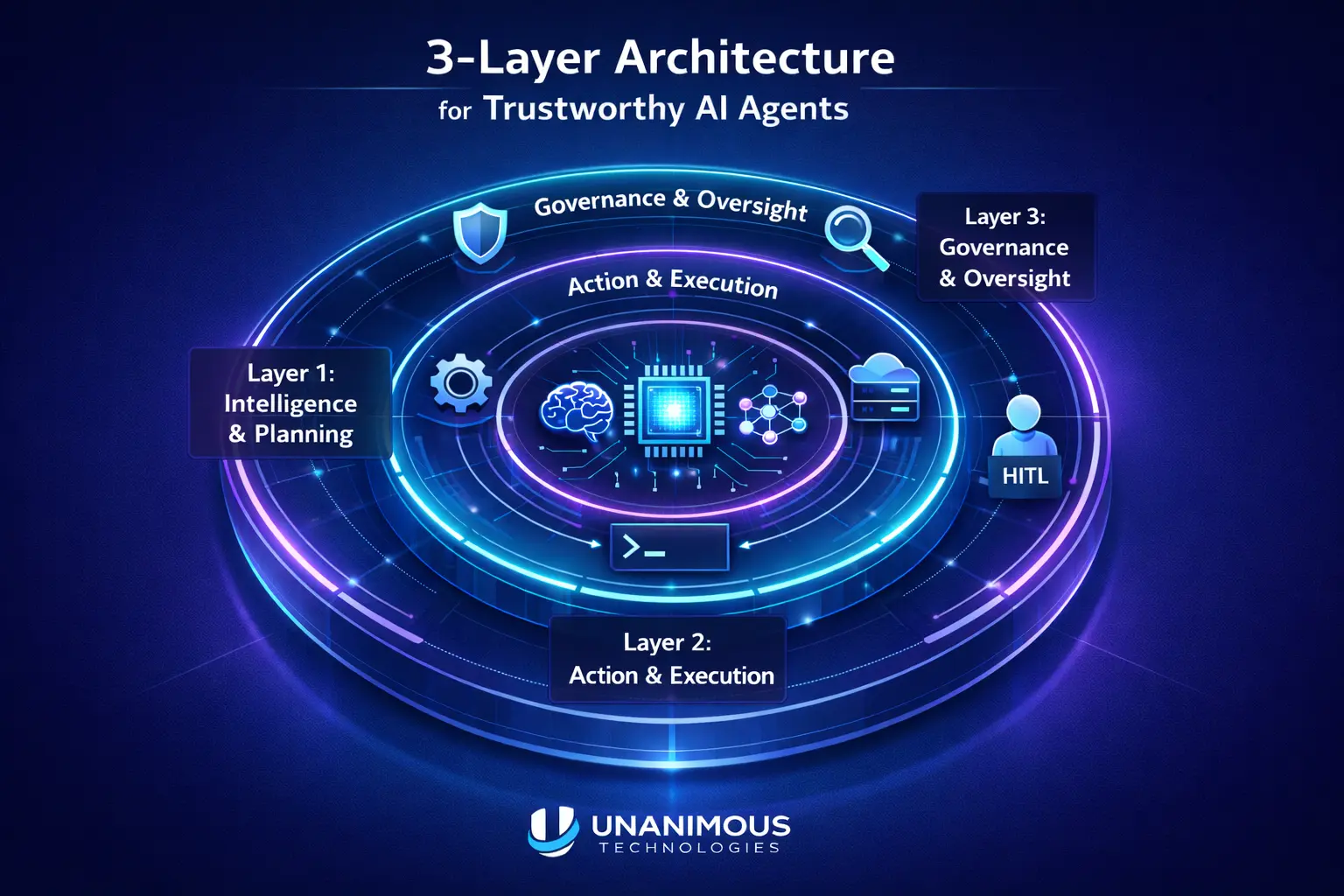
Developers must implement rigorous guardrails, verification steps, and human-in-the-loop triggers for high-stakes decisions. Implementing deterministic validation layers before an agent hits a production database ensures that the system’s actions remain bound by strict corporate safety parameters.
Security, Permissions, and Access Control
Granting an AI agent access to your corporate internal systems is a major security consideration. Standard security methodologies are tailored for human access configurations or static machine-to-machine tokens.
The “Agentic” architecture requires a new approach to access control, where agents operate under the Principle of Least Privilege. If an agent’s purpose is to manage customer success tickets, it must be programmatically isolated from human resource databases or corporate financial statements. Additionally, developers must secure agentic architectures against advanced attack surfaces like prompt injection, where malicious external data overrides the agent’s core system prompt to extract confidential data or trigger unintended API paths.
System Observability and Debugging
How do you debug an agent that takes a 10-step sequence to complete a task? If a traditional script fails on step 4, the stack trace indicates the exact line of code that threw an exception. If an AI agent fails on step 4, it might be because a minor nuance in step 1 altered its long-term planning loop, leading to an illogical tool execution several steps later.
Observability tools are now being built specifically to track agent reasoning paths and identify where a process went off-track. Engineering teams need clear insights into trace histories, prompt state logs, cost monitoring per task loop, and latency graphs to ensure their agent infrastructure runs reliably and cost-effectively at scale.
The Future: Multi-Agent Systems (MAS)
As the agentic landscape matures, single-agent architectures are revealing natural boundaries. Trying to construct an individual, monolithic agent that can write code, audit finances, talk to clients, and run marketing plans leads to context dilution and poor task execution.
The next step in this evolution is the Multi-Agent System (MAS). Rather than one giant “super-agent,” we will see the emergence of specialized agents—a researcher agent, a coder agent, and a project manager agent—collaborating to solve complex problems. This mimics the structure of human organizations, allowing for specialized foIn a Multi-Agent System, an orchestration layer distributes work based on specialized capability profiles. For example, when tasked with launching a new digital ad campaign:
- A Market Researcher Agent continuously sweeps web sources to analyze current competitor ad spend and consumer sentiment trends.
- It passes a structured brief to a Creative Director Agent, which drafts targeted advertising copy options and design prompts.
- An Operations Agent takes the approved copy, interfaces directly with the Meta or Google Ads API, monitors early campaign performance scores, and re-allocates financial budget dynamically based on the performance metrics.
By breaking down immense problems into a network of modular agents, enterprises achieve far higher execution accuracy, cleaner error handling, and unparalleled operational flexibility.
Conclusion: Preparing for the Agentic Era
The rise of AI agents marks the end of the “static software” era. We are entering a period where applications will be defined by their ability to act on our behalf. As developers, product managers, and business leaders, the opportunity is not just to integrate AI, but to rethink the entire user experience around the concept of autonomous goal achievement.
The companies that succeed in the next decade will be those that view AI not as a feature to be added, but as an agentic layer that empowers users to do more by doing less. The journey requires moving beyond simple proof-of-concepts into deploying production-grade frameworks that are secure, observant, and interconnected.
Ready to Build the Future with Unanimous Technologies?
Are you prepared to move beyond basic automation and integrate autonomous AI agents into your product suite? The transition to agentic workflows is complex, requiring deep expertise in architecture, security, and LLM orchestration. Missteps in access design or verification loops can put corporate integrity and data assets at risk.
At Unanimous Technologies, we specialize in helping forward-thinking enterprises design, develop, and deploy intelligent, agentic systems that scale safely. Whether you want to overhaul your customer success pipeline, inject developer agents into your dev-ops environment, or design a custom multi-agent network, our team brings the production experience you need. Don’t let your competition define the next generation of your software.
Book a Strategy Consultation with Unanimous Technologies Today and let’s explore how AI agents can revolutionize your specific workflows.