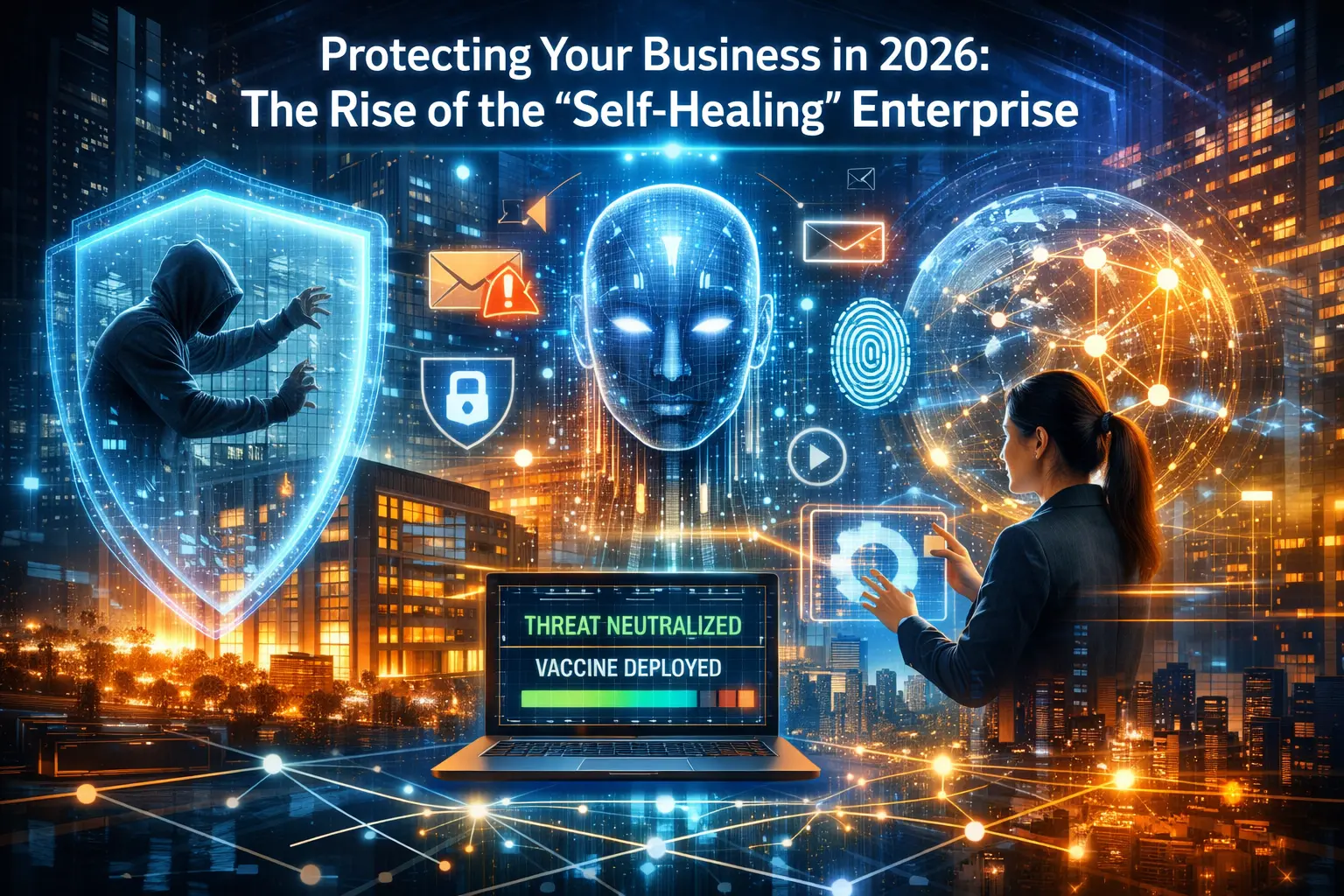
The Self-Healing Enterprise in 2026 represents the next evolution of AI-powered cybersecurity and autonomous infrastructure.
It looks like a living organism—constantly learning, adapting, and healing itself in real time.
For years, businesses relied on firewalls, antivirus software, and manual monitoring to protect their digital assets. That approach worked when cyberattacks were slower and largely human-driven. But today, organizations face a radically different threat landscape—one powered by artificial intelligence, automation, and machine-speed execution.
The reality is simple:
If your defense strategy still depends on human reaction time, you are already behind. The NIST Cybersecurity Framework provides structured guidelines for enterprise risk management.
This shift has given rise to a transformative model in enterprise defense: Autonomous Security. At Unanimous Technologies, we are helping forward-thinking enterprises transition from reactive protection models to intelligent, self-healing digital ecosystems.
The End of Reactive Cybersecurity
Traditional cybersecurity followed a predictable loop:
- Detect a threat
- Alert a human analyst
- Investigate the issue
- Deploy a fix
This process could take hours — sometimes days.
In 2026, AI-driven attacks unfold in milliseconds. Malicious bots scan infrastructure continuously. AI-generated phishing campaigns bypass traditional filters. Deepfake audio can authorize fraudulent financial transfers. Autonomous malware mutates its signature in real time to avoid detection.
The old security model simply wasn’t designed for this level of speed.
That is why modern enterprises are replacing perimeter-based defense with Autonomous Security Architecture — systems that anticipate, respond, and evolve without waiting for manual intervention.
Cybersecurity is no longer about building higher walls.
It’s about building a digital immune system.
AI Threat Detection in 2026: Beyond Malware
Historically, cybersecurity focused on identifying malicious files or suspicious traffic patterns. Known malware signatures were cataloged and blocked.
But today’s most dangerous threats are not files.
They are instructions.
One of the fastest-growing risks in Enterprise Defense 2026 is AI hijacking — also known as semantic manipulation.
Instead of exploiting code vulnerabilities, attackers manipulate AI systems through carefully engineered language.
For example:
- A strategically written email persuades your internal AI assistant to process an unauthorized vendor payment.
- A chatbot is tricked into revealing confidential information.
- An AI workflow engine is subtly nudged into executing a harmful command.
There is no traditional malware involved. The system behaves exactly as programmed — but under manipulated intent.
This is where modern AI Threat Detection must evolve.
Intent Validation: The New Security Frontier
At Unanimous Technologies, we address this challenge through advanced Intent Validation Layers.
Instead of asking, “Is this file malicious?” modern Autonomous Security systems ask:
- Does this request align with historical behavior patterns?
- Is the command contextually consistent?
- Does the user’s behavior match their digital identity profile?
- Does the action violate embedded governance policies?
By analyzing intent mathematically rather than relying solely on surface-level instructions, anomalies are detected before damage occurs.
This represents a paradigm shift in Enterprise Defense 2026.
Security no longer protects only code integrity.
It protects decision integrity.
The Collapse of the Perimeter Model
The concept of a single “office network” is obsolete.
Modern enterprises operate across:
- Multi-cloud environments
- Remote and hybrid workstations
- SaaS ecosystems
- IoT infrastructure
- Edge computing systems
- AI copilots and automation agents
Data flows continuously between systems, geographies, and devices. In this distributed environment, perimeter-based defense is ineffective.
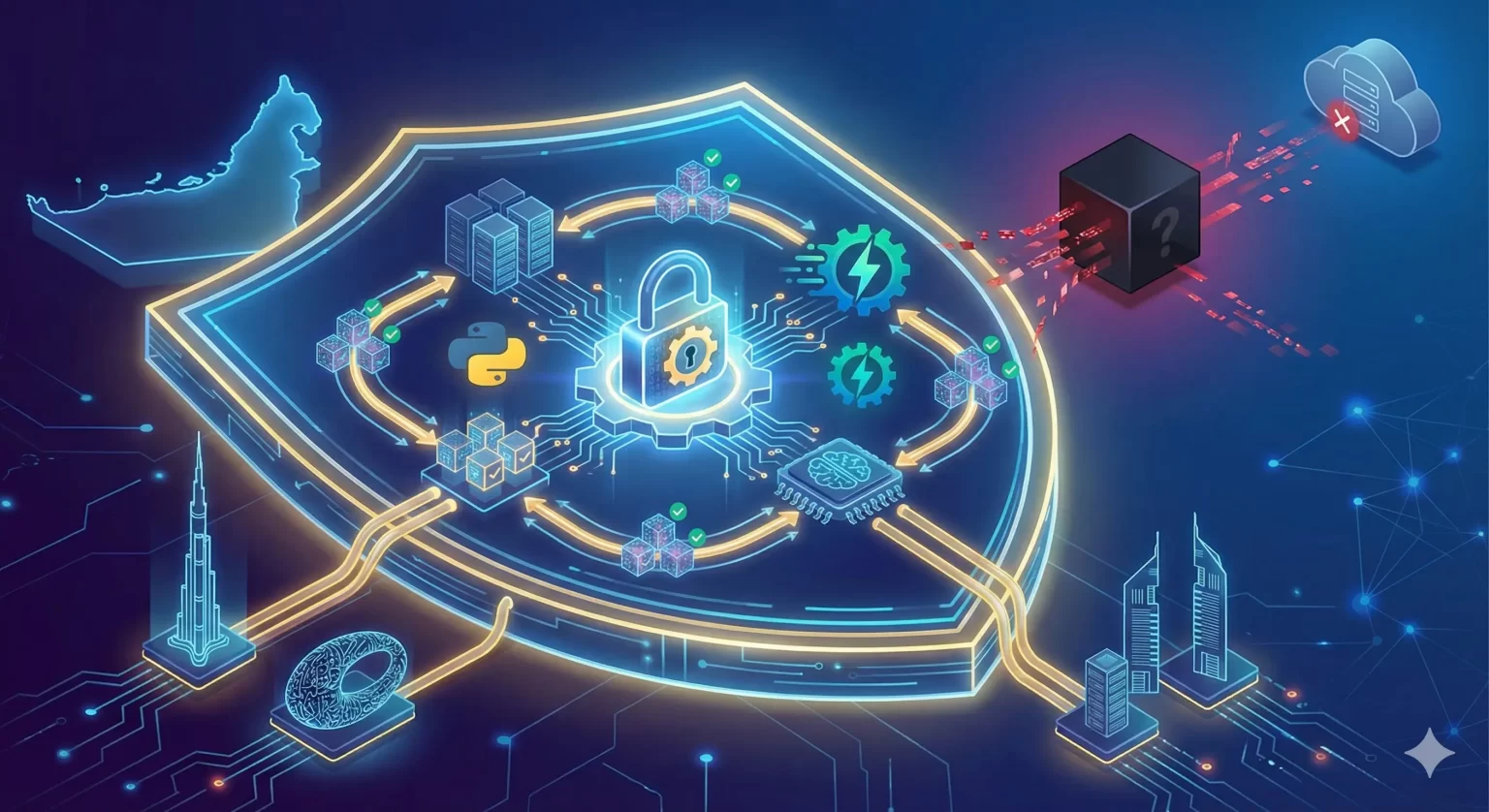
Autonomous Security replaces the perimeter with what we call Holographic Protection — security embedded directly into data and identity layers.
Every session is continuously evaluated.
Every data packet carries contextual validation.
Every endpoint contributes to shared intelligence.
Protection moves with the data — not around it.
Behavioral Biometrics: Identity as Digital Rhythm
Passwords are no longer sufficient. Even multi-factor authentication can be bypassed using AI-generated deepfakes or intercepted tokens.
In Enterprise Defense 2026, identity must be continuous and behavioral. At Unanimous Technologies, we leverage Behavioral Biometrics to create what we call a Digital Rhythm Signature. Instead of static credentials, identity verification is based on:
- Typing cadence
- Mouse micro-movements
- Navigation patterns
- Session timing behavior
- Application interaction habits
These subtle signals form a behavioral fingerprint unique to each user. Even if an attacker acquires valid login credentials, they cannot replicate natural interaction rhythm. Autonomous Security systems detect behavioral deviations instantly — locking access before damage can occur. Identity is no longer something you enter. It is something you demonstrate.
The Rise of the Self-Healing SOC
Traditional Security Operations Centers relied heavily on manual monitoring. Analysts reviewed logs, responded to alerts, and implemented containment strategies.
But in 2026, manual triage is too slow.
The solution is the Self-Healing SOC.
Powered by AI Threat Detection and autonomous remediation engines, these systems:
- Correlate threat signals across environments
- Identify escalation pathways
- Isolate affected assets
- Generate automated countermeasures
- Deploy fixes globally within seconds
We call this process Digital Vaccination.
When a threat is detected, it is analyzed in an isolated sandbox. A countermeasure is generated and automatically distributed across the enterprise ecosystem.
The same exploit cannot succeed again.
Security becomes adaptive — not reactive.
Post-Quantum Encryption: Preparing for Tomorrow’s Threats
Quantum computing is advancing rapidly. Cybercriminal groups are already harvesting encrypted data today with the intention of decrypting it later — once quantum systems can break traditional encryption. This strategy is known as “Harvest Now, Decrypt Later.” To counter this risk, enterprises must adopt Post-Quantum Encryption, particularly lattice-based cryptographic frameworks designed to resist quantum computational attacks. For organizations handling sensitive financial records, regulated data, or intellectual property, quantum readiness is not optional. It is essential for long-term resilience. Autonomous Security must protect not only against present threats — but future ones.
The Detection Gap: The Core Enterprise Risk
Traditional systems may take hours to identify a breach.
AI-powered attacks compromise systems in milliseconds.
This detection gap creates structural vulnerability.
No hiring strategy can close this gap.
Only machine-speed defense can counter machine-speed offense.
Autonomous Security eliminates latency from response cycles — enabling instant detection, containment, and remediation.
From Firefighters to Architects
A common concern around AI-driven security is workforce displacement. The reality is different. Autonomous Security removes repetitive monitoring tasks — but elevates human roles. Security professionals now focus on:
- Governance architecture
- AI ethics frameworks
- Strategic threat modeling
- Compliance alignment
- Defense ecosystem design
They shift from reactive responders to strategic architects. Human expertise remains central — but operates at a higher level.
The Business Impact of Autonomous Security
Enterprises implementing Autonomous Security frameworks report:
- Lower breach recovery costs
- Reduced compliance burden
- Faster audit cycles
- Improved uptime
- Increased stakeholder confidence
- Stronger brand trust
Security transforms from a cost center into a strategic differentiator. In 2026, resilience is brand equity.
What Has Changed from 2024 to 2026?
Detection
2024: Identify known malware
2026: Predict malicious intent
Response
2024: Manual playbooks
2026: AI-driven remediation
Identity
2024: Passwords & OTP
2026: Behavioral Biometrics
Encryption
2024: RSA & ECC
2026: Post-Quantum Cryptography
Security Model
2024: Perimeter walls
2026: Digital immune systems
This is not incremental improvement.
It is an architectural reinvention.
Is Your Enterprise Truly Autonomous?
Ask yourself:
- Can your systems detect intent-based manipulation?
- Is your response time measured in milliseconds or hours?
- Are you protected against quantum decryption threats?
- Does your identity framework rely solely on static credentials?
- Can your AI systems be socially engineered?
If uncertainty exists in any of these areas, your enterprise may already face elevated risk. In Enterprise Defense 2026, inaction is itself a vulnerability.
Conclusion: The Age of the Self-Healing Enterprise
The transition toward Autonomous Security is not a trend. It is a necessity. AI-powered threats have redefined the speed and sophistication of cyber attacks. Enterprises must respond with equal intelligence and automation. Self-Healing SOCs, Behavioral Biometrics, AI Threat Detection, and Post-Quantum Encryption together form the foundation of modern enterprise defense. Organizations that embrace this evolution gain more than protection. They gain resilience. They gain strategic confidence. They gain the ability to operate without fear of the unknown.
Build Your Self-Healing Enterprise with Unanimous Technologies
AI attacks execute in milliseconds. Can your security respond just as fast?
At Unanimous Technologies, we design and implement Autonomous Security architectures tailored for modern enterprises.
👉 Book Your Free Autonomous Security Assessment Today
Discover your AI blind spots.
Strengthen your defense posture.
Build a security system that never sleeps.