In the rapidly evolving landscape of artificial intelligence, we are moving beyond mere automation and into the era of Agentic AI. These intelligent, autonomous systems are designed not just to process information but to take actions, make decisions, and even self-correct without constant human oversight. From automating complex DevOps pipelines to managing customer interactions, AI agents promise unprecedented efficiency and innovation.
However, deploying AI agents into production—especially in critical enterprise environments—introduces a unique set of challenges. Trust, reliability, security, and explainability become paramount. How do we ensure these agents perform as expected, don’t go “off-script,” and can be held accountable? The answer lies in a robust, multi-layered architectural approach.
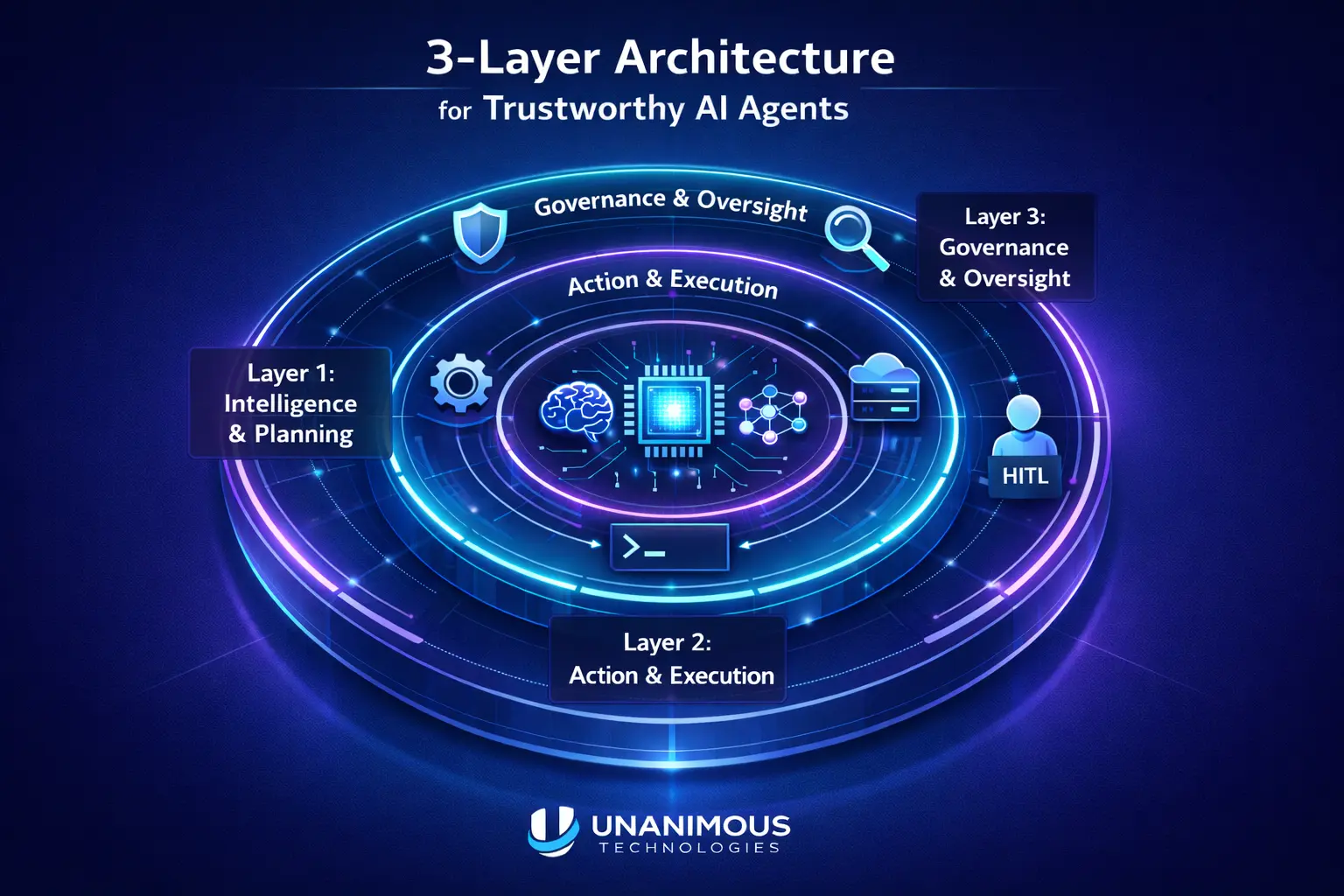
At Unanimous Technologies, we’ve identified and refined a 3-Layer Architecture that forms the bedrock of every trustworthy, production-ready AI agent. This architecture provides the necessary scaffolding for agents to operate effectively, securely, and transparently, ensuring they deliver on their promise without introducing undue risk.
Understanding the Paradigm Shift: From Automation to Autonomy
Before diving into the architecture, it’s crucial to grasp why a new approach is necessary. Traditional automation, while powerful, is largely deterministic. It follows predefined rules and scripts. When it encounters an unforeseen scenario, it typically stops and alerts a human.
Agentic AI, conversely, aims for autonomy. It possesses:
- Goal-Orientation: It’s given a high-level objective, not a detailed sequence of steps.
- Perception: It can interpret its environment (e.g., read system logs, analyze market data).
- Reasoning/Planning: It can devise a plan to achieve its goal, adapting to real-time information.
- Action: It can execute actions in its environment (e.g., deploy code, modify a database, interact with a user).
- Memory/Learning: It can retain information from past interactions and learn to improve its performance.
This autonomy is its greatest strength and its greatest potential vulnerability. Without proper controls, an agent could deviate from its intended purpose, make costly mistakes, or even introduce security risks. This is where the 3-Layer Architecture becomes indispensable.
Layer 1: The Core Intelligence & Planning Layer (The Brain)
This is the heart of the AI agent, responsible for its cognitive functions. It encompasses the agent’s ability to understand its goals, reason about its environment, plan actions, and learn from experience. This layer needs to be powerful yet predictable, intelligent yet controllable.
A. Large Language Models (LLMs) and Small Language Models (SLMs)
At the foundation of many modern AI Agent Architectures lies a Language Model.
- LLMs: Powerful general-purpose models (like GPT-4, Claude) provide strong reasoning, world knowledge, and adaptability. They excel at understanding complex instructions, generating nuanced responses, and performing sophisticated multi-step reasoning. They are often used for high-level planning or when an agent needs to generalize across many domains.
- SLMs: Smaller, fine-tuned models tailored to specific domains (e.g., a code generation SLM, a financial analysis SLM) offer cost-efficiency, faster inference, and often higher accuracy for narrow tasks. For production AI Agents, an SLM might handle routine tasks or act as a specialized “tool” invoked by a larger LLM.
The choice and integration of these models are critical. An effective production agent might use an LLM for strategic planning and an SLM for precise execution within a specific domain.
B. Reasoning and Planning Engine
This component takes the agent’s goal and current perception and formulates a plan of action. This isn’t just about single-step responses; it’s about multi-step problem-solving.
- Chain-of-Thought (CoT) / Tree-of-Thought (ToT): These advanced prompting techniques enable LLMs to “think step-by-step,” breaking down complex problems into manageable sub-problems, exploring multiple paths, and even self-correcting. This improves reliability and reduces hallucination.
- State Machines/Finite Automata: For critical, deterministic workflows, explicitly defined state machines can guide the agent’s behavior, ensuring it follows pre-approved paths and transitions. The LLM might propose actions, but the state machine validates them.
- Goal Decomposition: The ability to break down a high-level goal (e.g., “Deploy new microservice”) into actionable sub-goals (e.g., “Build container image,” “Run tests,” “Update Kubernetes manifests”).
C. Memory and Context Management
Production AI agents need to remember past interactions and relevant information to maintain coherence and perform effectively over time.
- Short-Term Memory (Context Window): Managed by the LLM’s prompt, this holds the immediate conversation history and current task-specific details.
- Long-Term Memory (Vector Databases, Knowledge Graphs): For persistent information, agents interact with external knowledge stores.
- Vector Databases: Store embeddings of documents, code snippets, logs, or past actions, allowing the agent to retrieve relevant information via semantic similarity (e.g., Retrieval Augmented Generation – RAG). This prevents the agent from “forgetting” crucial details or historical context.
- Knowledge Graphs: Represent relationships between entities, providing structured context that enables more sophisticated reasoning and inference.
D. Learning and Adaptation Modules
True autonomy implies the ability to learn and improve.
- Reinforcement Learning (RL): While complex, RL techniques can enable agents to learn optimal policies through trial and error in simulated environments, especially for dynamic control tasks.
- Feedback Loops: Mechanisms to capture human feedback (e.g., “Was this action correct?”), evaluate agent performance against KPIs, and use this data to fine-tune models or adjust agent policies.
- Observational Learning: Agents can learn by observing human experts performing tasks, extracting patterns and best practices.
Why this layer is crucial for trust: A well-designed Core Intelligence Layer means the agent can understand its mission, adapt to new information, and make sound decisions, reducing the likelihood of unexpected or erroneous behavior.
Layer 2: The Action & Execution Layer (The Hands and Feet)
This layer empowers the AI agent to interact with the real world, translating its plans into concrete actions. It’s where the rubber meets the road, and thus, where robust tooling and secure interfaces are paramount.
A. Tool Orchestration and API Integration
Agents don’t operate in a vacuum; they interact with existing systems through tools.
- Function Calling: LLMs can be prompted to output structured calls to external functions or APIs. The agent architecture needs to facilitate this by providing a well-defined registry of available tools (e.g., a kubectl tool, a Jira API tool, a Salesforce tool).
- Tool Wrappers: These are crucial. Instead of directly exposing raw APIs, specific wrappers abstract complexity, sanitize inputs, and validate outputs. They define what an agent can do with a tool and how it should do it.
- Service Mesh Integration: For microservices environments, integrating with a service mesh (e.g., Istio, Linkerd) allows for fine-grained control over agent-to-service communication, including authentication, authorization, and traffic management.
B. State Management and Persistence
An agent’s actions often change the state of external systems. Robust state management ensures consistency and recoverability.
- Transactional Execution: For multi-step actions, the ability to commit or rollback changes ensures data integrity. If an agent fails midway through a deployment, the system should revert to a stable state.
- Idempotency: Designing tools and actions to be idempotent ensures that executing the same action multiple times has the same effect as executing it once. This is vital for retry mechanisms and fault tolerance.
- Distributed Tracing: Implementing tracing (e.g., OpenTelemetry) helps track the flow of an agent’s actions across multiple systems, providing visibility into its execution path and aiding in debugging.
C. Sandbox and Environment Isolation
For production AI agents, limiting their blast radius is non-negotiable.
- Containerization (Docker, Kubernetes): Running agents within isolated containers provides a consistent environment and prevents them from impacting the host system or other applications. Kubernetes offers orchestration for managing multiple agent instances securely.
- Least Privilege Access: Agents should only have the minimum necessary permissions to perform their designated tasks. This principle is critical for security; if an agent is compromised, the potential damage is minimized.
- Temporary Credentials: Using short-lived, dynamically provisioned credentials for API access (e.g., via AWS IAM Roles, Azure Managed Identities) reduces the risk associated with static access keys.
D. Observability and Monitoring Hooks
Just as with any critical software, agents need to be continuously monitored.
- Logging: Comprehensive, structured logging of agent decisions, actions, tool calls, and outcomes. This is invaluable for auditing, debugging, and understanding agent behavior.
- Metrics: Tracking KPIs related to agent performance (e.g., success rate of actions, latency of responses, resource utilization).
- Alerting: Configuring alerts for anomalous agent behavior, failures, or performance degradation ensures human operators are notified promptly.
Why this layer is crucial for trust: A well-architected Action & Execution Layer ensures that agents can perform tasks effectively, predictably, and securely, with mechanisms in place to prevent unintended side effects and quickly address any issues.
Layer 3: The Governance & Human Oversight Layer (The Watchtower)
This layer is perhaps the most critical for achieving true trustworthiness in production. It provides the necessary guardrails, accountability, and transparency mechanisms that allow humans to remain in control and understand the agent’s behavior. This is where AI Governance truly comes into play.
A. Policy Enforcement and Guardrails
These mechanisms prevent agents from acting outside their defined boundaries or violating critical rules.
- Behavioral Constraints: Explicitly programming “don’t do X” rules. For instance, an agent for a customer support chatbot might be forbidden from discussing specific sensitive topics or accessing certain customer data.
- Resource Limits: Ensuring agents don’t consume excessive compute, network, or API resources, preventing runaway costs or denial-of-service scenarios.
- Ethical AI Guidelines: Translating ethical principles (fairness, privacy, transparency) into actionable, enforceable policies within the agent’s operational framework. For example, ensuring a hiring agent doesn’t use protected demographic information in its decision-making.
B. Human-in-the-Loop (HITL) Mechanisms
While aiming for autonomy, certain high-stakes decisions or uncertain situations require human approval.
- Approval Workflows: For critical actions (e.g., deploying to production, modifying sensitive data, making financial transactions), the agent proposes an action, and a human operator reviews and approves or denies it.
- Escalation Paths: When an agent encounters an unresolvable problem or a situation outside its defined capabilities, it must gracefully escalate to a human operator, providing all relevant context.
- Intervention & Override: Human operators must have the ability to pause, stop, or directly override an agent’s actions at any point, providing an essential safety switch.
C. Explainability and Auditability (XAI)
For an agent to be trusted, its decisions and actions must be understandable and auditable.
- Action Log (Audit Trail): A comprehensive, immutable record of every decision made, every action taken, and the rationale (if available) behind it. This is essential for compliance, debugging, and post-incident analysis.
- Decision Rationale Generation: The agent should be able to explain why it chose a particular action or reached a specific conclusion. This could involve highlighting the most influential parts of its input, citing relevant knowledge sources, or outlining its reasoning steps.
- Transparency Reports: Periodically generating reports on agent performance, adherence to policies, and any observed biases or anomalies.
D. Continuous Auditing and Red Teaming
Proactive security and safety measures are crucial for production AI agents.
- Security Audits: Regular, independent audits of the agent’s code, data, and interactions with external systems to identify vulnerabilities.
- Red Teaming: Actively trying to “break” the agent, find its weaknesses, and exploit them (e.g., through adversarial prompting) to understand its failure modes and improve its robustness.
- Compliance Checks: Ensuring the agent’s operations comply with industry regulations (e.g., GDPR, HIPAA, financial regulations).
Why this layer is crucial for trust: The Governance & Human Oversight Layer transforms autonomous agents from potential liabilities into controllable, accountable assets. It ensures that while agents operate with intelligence, humans retain ultimate authority and understanding.
Implementing the 3-Layer Architecture with Unanimous Technologies
At Unanimous Technologies, we don’t just understand the theoretical framework; we specialize in engineering and deploying production AI agents that embody this robust 3-Layer Architecture.
Our approach integrates:
- Advanced LLM/SLM Orchestration: We select and fine-tune the right models for your specific use cases, building custom reasoning engines tailored to your enterprise needs.
- Secure Tooling Integration: We develop secure, idempotent tool wrappers and integrate seamlessly with your existing enterprise APIs and service meshes, ensuring safe and controlled execution.
- Comprehensive Governance Frameworks: We implement robust policy engines, human-in-the-loop workflows, and provide end-to-end audit trails and explainability features that satisfy the strictest compliance and security requirements.
- Continuous Monitoring and Feedback: Our solutions include proactive monitoring, alerting, and feedback mechanisms that ensure your AI agents are always performing optimally and learning adaptively.
We help organizations move beyond experimental AI projects to deploy trustworthy AI agents that deliver tangible business value, enhance operational efficiency, and maintain the highest standards of security and accountability.
Conclusion: Building the Foundation for Agentic Trust
The future of enterprise automation is agentic. As AI agents become more sophisticated and take on increasingly critical roles, the demand for architectures that guarantee their trustworthiness will only grow. The 3-Layer Architecture—comprising the Core Intelligence & Planning Layer, the Action & Execution Layer, and the Governance & Human Oversight Layer—provides the essential blueprint for building AI agents that are not only powerful and efficient but also reliable, secure, and transparent.
By meticulously designing each layer, organizations can unlock the full potential of autonomous AI without compromising on control, accountability, or ethical standards. Unanimous Technologies is committed to guiding businesses through this transformative journey, ensuring that your AI agents are not just intelligent, but also universally trusted in production environments.
Are you ready to build the next generation of production AI agents with a foundation of trust and reliability?
Contact Unanimous Technologies today to explore how our expertise can empower your enterprise.